
Do you sometimes wonder if you’re feeling crazy or overreacting? Or does your partner deny their responsibilities and shift the blame to you?
If yes, you might be experiencing emotional abuse! Remember, you are not alone, and your feelings are valid.
Emotional abuse is a pattern of behavior that controls, frightens, manipulates, or isolates the other person. It’s a pattern of mistreatment rather than a single incident.
It is harder to recognize, as physical abuse leaves bruises on the skin. It leaves lasting effects on an individual’s life, which erode a person’s self-esteem, confidence, and mental peace.
Anyone can experience emotional abuse at any stage of life, whether it’s a romantic relationship, a parent, a caretaker, or even your adult child.
However, many individuals live through emotional abuse for months or years without realizing what is happening to them.
Understanding this condition can help in early diagnosis and provide better ways to manage it.
What is Emotional Abuse?
Emotional abuse is a way to control someone by using feelings of shame and manipulation. People experiencing this abuse often feel stuck, isolated, and unworthy. The abusers use tactics like constant criticism, gaslighting, humiliation, pressure, and threats. However, all these behaviors leave an individual to question their self-worth and make them stay isolated from others. It leaves devastating psychological effects on the overall well-being.
Emotional abuse often occurs in a cycle that makes it harder for the victim to recognize the ongoing harm. It is common in married relationships, friends, family members, and co-workers.
What Emotional Abuse Looks Like?
It is not always obvious. It can be quiet, repeated, and disguised as love or concern. The abuser makes the other person feel like they are too sensitive, never good enough, or too demanding. They make them feel guilty even for the things in which they don’t have any fault.
Common Signs of Emotional Abuse
This condition can occur differently from other types of abuse. Here are some signs that can help you identify emotional abuse.
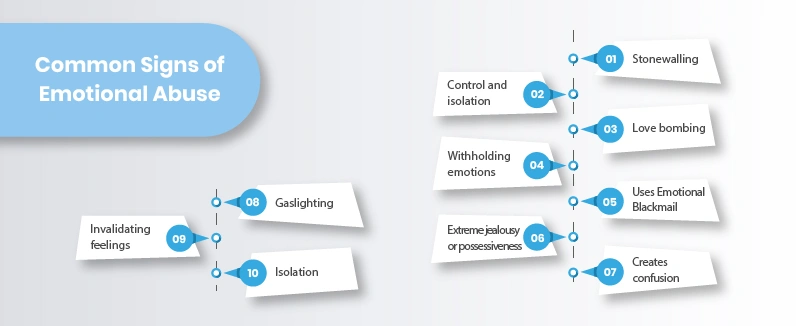
- Control and isolation
The person who is manipulating tries to control their partner by making them follow their instructions. They may be told who they meet and how much time they can spend with others. It can also occur in the form of constant monitoring of your social media, texts, and phone calls.
- Stonewalling
It is a nonverbal form of emotional abuse. It manifests in a way that may look like refusing to respond, not making eye contact, dismissing feelings, or walking away from a discussion. This way, they internally, emotionally abuse the other person.
- Withholding emotions
A person who is abusing and withholding their emotions shows anger without clarifying the situation. It causes anxiety in the person who is experiencing the abuse, as it leads to fear. They may feel like they are unworthy to be loved, or they will be left alone.
- Love bombing
Love bombing is also a manipulative tactic. The manipulators use overloaded compliments and gifts to their partner. However, it can then be turned around and used later on as manipulation. Love bombing often comes after an intense rage of irrational behavior displayed by your partner.
Read More: What is Erratic Behavior? Symptoms, Causes, and Treatments
- Extreme jealousy or possessiveness
Extreme possessiveness and controlling behavior are the red flags of emotional abuse. If your partner watches every step you take, accuses you of disloyalty, or becomes angry if you decide to spend time with others, it can be considered emotional abuse. Their possessiveness is often a way to exert their dominance over you.
- Uses Emotional Blackmail
People in this state use your emotions against you. For example, insulting you in public, using your weak points and fear, or other things to control you or the situation. They may exaggerate your flaws and point them out just to make you feel ashamed and guilty. The abuser doesn’t take any responsibility for their wrongdoing, instead blaming the other person.
- Creates confusion
It is also another tactic of emotional abuse. As the abuser starts argumenting on the things that are not that important. They make unnecessarily confusing statements just to annoy the other person. People who are abused make sudden shifts in mood and outburst anger, they behave so erratically that one may feel like they are “walking on eggshells.”
- Invalidating feelings
The abuser misjudges the feelings and makes one feel unseen and unheard. They blame the victim for being dramatic, overly sensitive, or insecure. They discourage them from expressing their true feelings. However, these repeated invalidations can eventually lead to self-doubt, suppressing emotions.
- Gaslighting
Gaslighting is a form of psychological and emotional abuse that makes one question one’s self-worth, memory, or reality. The continuous gaslighting causes confusion and self-doubt, which leads to a loss of confidence and makes one rely on an abusive partner. Gaslighting causes serious long-term effects on your mental health, leading to deep emotional trauma.
Read More: What Are The Traits Of A Vulnerable Narcissistic Personality Disorder?
- Isolation
The emotional abuser always tries to make one feel alone by isolating them from friends and family members. They make negative comments, flaws, or flat-out lies to prevent the one from having contact with loved ones. This social isolation is a deliberate effort to make one more dependent on them. They eliminate the outside influence, so no one convinces them that they are treated poorly.
How Does the Cycle of Abuse Work?
Emotional abuse occurs in a loop that makes it extremely difficult to leave. This cycle of abuse is a theory developed by Lenore E. Walker in 1979. It is designed to show the recurring patterns of behavior in an abusive relationship.
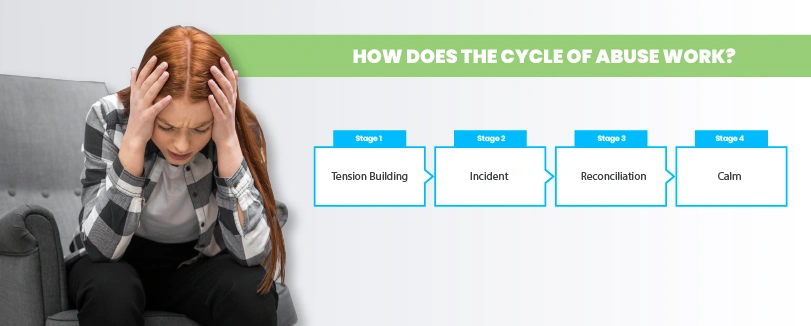
However, this cycle generally involves four stages, which include:
Stage 1: Tension Building
In the first stage, the abuser’s communication breaks down. The person experiencing abuse feels like a “walking on eggshells” to avoid upsetting the abuser.
Abuser behavior: Extreme irritability, mood swings, and minor emotional outbursts. They often use the silent treatment to hurt the other person.
Victim response: The person who is going through abuse becomes hyper-vigilant, trying to remain silent to prevent an outburst.
Stage 2: Incident
The excessive built-up stress breaks into an overt act of abuse. However, this can be triggered by the abuser’s internal emotional state instead of the victim’s actions.
Abuser tactics: Individuals in this stage make verbal attacks (yelling, insults), gaslighting, or exhibit extreme controlling behaviors.
Victim reaction: The person who is experiencing all this feels shocked, confused, and frightened.
Stage 3: Reconciliation
At this stage, the abuser enters “damage control” mode. It is the stage where the victim might leave, so they convince them by doing certain behaviors.
Abuser behavior: They suddenly change their behavior and show intense affection, apologies, and make promises that they will change. They use lovebomber tactics just to please them or minimize the incident.
Victim response: The victim may feel like they might be changed, feel relief, and have a sense of hope.
Stage 4: Calm
At this stage, individuals may feel like everything is back to normal again, and the abuse is often swept under the rug.
Behavior of the abuser: the behavior changes after apologizing, justifying their actions, or even pointing out that the victim provoked them.
The Result: In this period, a relief is provided by the abuser.
✓ Therapy & Medication Management
✓ Telehealth & In-Person Visits
✓ Most Major Insurances Accepted
The Effects of Emotional Abuse
Emotional abuse is often invisible and leads to isolation. The person experiencing this may look fine on the outside, while they are carrying a heavy burden of fear, shame, and confusion. However, if the abuse is repeated constantly, it severely affects mental health, relationships, and even leads to physical health issues. The emotional abuse makes one go against themselves and think in this way, which eventually leads them to shame, fear, hopelessness, stress, anxiety, and guilt.
Also, it impacts children and leads them to behavioral issues. They may cling to someone for emotional security, show risky behaviors, become detached from important things, or become people pleasers.
Moreover, emotional abuse can also have led to physical health issues, such as body aches and pains, muscle tension, and trouble concentrating.
Note: Emotional abuse can also lead to PTSD. It is a severe mental health condition that makes it very difficult to recover from the abuse due to triggers. These triggers relive and again make one feel traumatised.
How to Spot Emotional Abuse?
Here are some signs and steps that may help you in spotting the red flags:
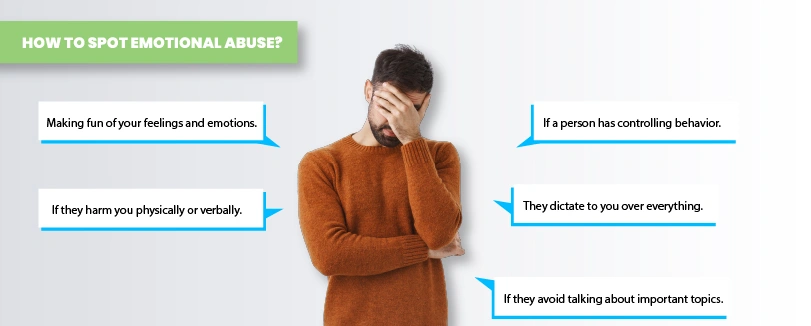
- If a person has controlling behavior.
- If they monitor your activities and take your decision on their own.
- They dictate to you over everything.
- If they avoid talking about important topics.
- Making fun of your feelings and emotions.
- If they harm you physically or verbally.
- If they play blame games.
- Keeping secrets from you.
How to Heal from Emotional Abuse
Healing from emotional abuse is possible with the right treatment methods. A mental healthcare expert helps individuals to acknowledge the cycle of emotional manipulation through therapeutic approaches. Some of the common therapies that may help the individual to overcome abuse include:
Cognitive Behavioral Therapy (CBT):
CBT is an evidence-based therapy that has proven effective for helping individuals who have been abused. It helps by changing the negative thoughts into positive ones. People who are suffering from this condition have feelings of worthlessness, guilt, low self-esteem, and more. CBT targets unsettling thoughts and beliefs by intervening in thoughts by changing them into helpful ones.
Dialectical Behavior Therapy (DBT):
It is for those people who are struggling with abuse. DBT is based on the idea that two opposing things can co-exist. In therapy, it means that you can accept your thoughts and emotions and still move on from them by changing them into productive thoughts and emotions.
Moreover, Trauma Therapy, it helps people to overcome traumatic experiences. Therefore, trauma therapy such as Eye-Movement Desensitization and Response (EMDR) can be a beneficial treatment for trauma. In this therapy, you move your eyes in bilateral movement from left to right. This method stimulates the brain, helping it to desensitize the information about the traumatic event in the past.
Additionally, Support groups play an important role in reducing the symptoms of abuse. It provides a sense of connection with others and reduces isolation. Support groups provide a nurturing environment where you can talk about your issues without the fear of judgment and stigma. Individuals share their experience with others who are struggling with the same issues. However, people share tips and strategies to overcome the symptoms earlier.
Get Compassionate Support at Inland Empire Behavioral Group
If you or anyone you care about is suffering from emotional abuse, know that help is within reach.
At Inland Empire Behavioral Group, we provide an impressive facility for treating mental health disorders. Our approach integrates multiple therapies to support your mind. We offer compassionate care in a supportive environment where you can express your feelings and find a solution. So whether you are suffering from depression, anxiety, or any other mental health issues, we are here to help. You can also get treatments virtually through our telepsychiatric services.
Book your appointments now!