
What if the person you trusted the most in the world suddenly felt like a dangerous stranger? Or do you feel like your spouse is just an imposter, a replica in your home?
This frightening situation is named Capgras Syndrome.
Capgras delusion is a type of delusional misidentification that is very rare. People in this state believe that their loved ones or other people around them have been replaced with impostors. They have a very strong belief in it that nothing can change it. People with this disorder usually believe that an imposter has bad intentions, which leads them to become angry and violent.
Approximately 46.8 million people around the world struggle with Capgras syndrome. This delusion can be upsetting, not only for the person who is described as an imposter, but also for the person experiencing the delusion.
It is named after the French physician Joseph Capgras, who first described it in 1923.
However, it can arise as a result of brain injury or neurological and mental health conditions, which increase the risk of developing this condition, such as schizophrenia or dementia.
Understanding how it looks can help people to diagnose it earlier and help them to get treatment earlier.
What is Capgras Syndrome?
Capgras syndrome is also known as Capgras delusion. It’s a psychological disorder that is not common. It’s a delusional condition in which people believe that their family members or other persons are a duplicate (or double). They may recognize them by their appearance, but they don’t feel any bond with them, which makes them think that they are imposter.
Moreover, most of the time they think the imposter has bad intentions, which makes one get furious or even violent. It can affect anyone, whether male or female, but it’s more common in females, and there is also a chance that it can affect children. Interestingly, this delusional syndrome does not affect the voice, so people with the Syndrome may recognize their loved one when they speak to them, but don’t feel any emotional connection. This term is not classified in the Diagnostic and Statistical Manual of Mental Disorders, 5th edition (DSM-5). However, it can be a part of other disorders with DSM-5 diagnostic criteria, such as schizophrenia or schizoaffective disorder.
The History of Capgras Syndrome
Capgras syndrome (CS) is a delusional misidentification syndrome. In this syndrome, there is a false belief that an identical duplicate has replaced someone they know. This condition is named after Joseph Capgras, a French psychiatrist. CS was connected to hysteria, as seen predominantly in females.
The first case was a woman named Madame M., who complained that her family, neighbours, and loved ones were replaced by doubles. This condition is referred to as “I’illusion des sosies,” which translates to mean “the illusion of look-alikes.”
However, initially, this condition was considered to be a psychiatric condition because the symptoms resemble schizophrenia and schizoeffective disorder. But now it is recognized as a psychiatric and neurological condition.
It belongs to a family of misidentification disorders, including:
- Fregoli Delusion: It is the belief that other people are actually one person in different masks.
- Cotard Delusion: it is a strong belief that one is dead, decomposing, or missing internal organs.
What are the Symptoms of Capgras Syndrome?
It’s a rare condition, and every individual experiences it in a different way. The main symptom is that one may truly believe that there’s an imposter in place of someone else, it can be a caregiver, partner, or parent. However, the signs can also be different, as it depends on what’s causing the syndrome.
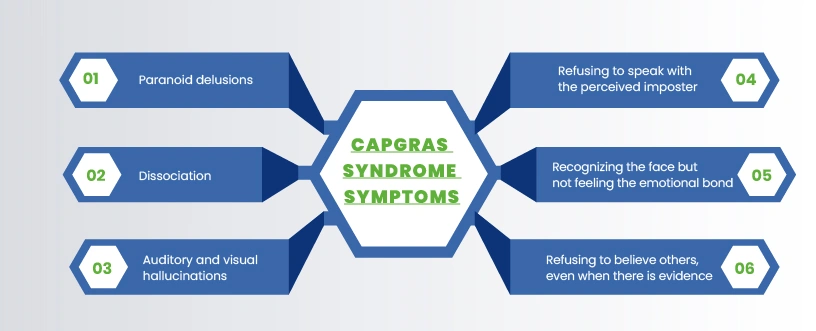
Here are some of the common symptoms that may help to recognize this condition:
- Paranoid delusions
- Dissociation
- Auditory and visual hallucinations.
- Refusing to speak with the perceived imposter.
- Recognizing the face but not feeling the emotional bond.
- Constantly expressing that an imposter makes them feel anxious or frightened.
- Showing aggressive behavior such as threatening the imposter or trying to attack them physically.
- Refusing to believe others, even when there is evidence
- Becoming concentrated on exposing the imposter.
- People experiencing this state may believe their home is a replica and that even their pets are imposters.
Individuals with this syndrome often believe that the imposter has harmful intentions, which ultimately makes them hostile toward the person they think is a double.
What are the Causes of Capgras Syndrome?
Capgrass syndrome usually occurs because of the disconnection between the temporal lobe, which helps in facial recognition, and hormones like the amygdala. The amygdala processes the emotional response when an individual recognizes someone. However, people in this state recognize others, but they don’t believe that they’re the same person. Mental health experts still don’t know exactly how Capgras syndrome develops, but they think there is a broken connection between the central nervous system and the extended nervous system.
In most people, this condition is considered to be a side effect of Alzheimer’s disease or dementia. It is because people with Alzheimer’s disease & dementia forget about their loved ones and their memories. As it severely impacts the minds can distort their sense of reality. Not everyone can develop this, but it can be considered a risk factor. Also, people who have experienced schizophrenia and brain injuries. However, there is still research going on into the conditions that may increase the risk of having this delusional syndrome.
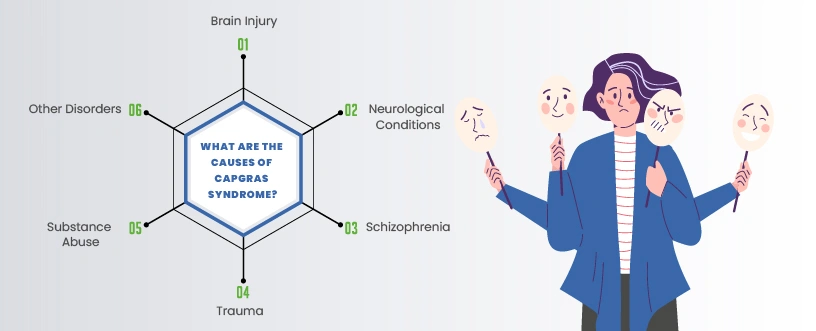
Here is a list of factors that may trigger this condition.
1. Brain Injury
People who are experiencing Capgras delusion usually have lesions or damage in the brain, particularly the right hemisphere. The brain is a complex part and can be damaged by any traumatic injury, such as accidents, strokes, or neurological diseases. The damage to the temporal cortex causes one to lose the ability to recognize familiar faces visually. It affects different areas of life, leading to the delusional misidentification of familiar individuals.
However, there are some changes that arise for a shorter period of time, and there are some that occur permanently.
2. Neurological Conditions
Capgras syndrome may occur with neurological conditions in which people experience dementia, such as Alzheimer’s disease (AD) and Lewy body dementia. These conditions cause intense damage to the brain, affecting memory and can alter the person’s sense of reality.
3. Schizophrenia
People who struggle with schizophrenia may experience these delusions, as these are the psychotic symptoms of their specific condition. This condition severely affects the brain’s ability to process the real world, and it sometimes results in misidentification syndromes.
4. Trauma
Excessive stress and trauma can make one prone to develop delusional thinking. It is because extreme psychological distress makes one develop this syndrome as a coping mechanism to deal with their perception of reality.
5. Substance Abuse
People who are prone to substances such as alcohol, marijuana, and cocaine are at high risk of developing this condition. It is because excessive intake of recreational drugs leads to issues with the brain, which can cause Capgras syndrome.
6. Other Disorders
There are some other causes that can also lead to the development of this syndrome, including the following:
- Epilepsy
- Stroke
- Brain tumor
- Advanced Parkinson’s disease
- Metabolic conditions
- Hypothyroidism
- Nutrient deficiencies
What Are the Mental Health Conditions Associated with Capgras Syndrome?
This condition is associated with several mental health conditions. As per the research, it usually occurs because of schizophrenia or schizoaffective disorder, or may also be a feature of dementia.
Here are some of the conditions that may coexist with this condition:
- paranoid schizophrenia
- schizoaffective disorder
- Parkinson’s disease
- Alzheimer’s disease
- Lewy body dementia
Approximately 16% of people with Alzheimer’s disease experience Capgras syndrome.
How Capgras Syndrome Can Impact Life?
Capgras Syndrome leads to several consequences in everyday life. It severely affects the individuals as well as their relationships. People living with this condition experience extreme fear, confusion, and paranoia. It is because they strongly believe that their loved ones have been replaced and are fake. However, this ultimately leads to emotional distress, anxiety, and depression.
Moreover, this delusional belief makes them doubt others, which causes them to avoid social gatherings. They tend to remain alone most of the time, which heightens feelings of sadness and further worsens mental health. People in this state also experience cognitive impairments because of the brain injury, which reduces their ability to perform everyday tasks.
✓ Therapy & Medication Management
✓ Personalized Treatment Plans✓ Telehealth & In-Person Visits
✓ Most Major Insurances Accepted
Impact on Relationships
People in this state remain in delusions that their loved one is an impostor, which can impose immense strain on relationships. They are unable to trust their partners. They accuse their partners. This causes tension and interpersonal conflicts. Moreover, it is also very difficult for caregivers.
Taking care of someone with CS can be emotionally taxing. Caregivers may experience Burnout, tension, low motivation, and feelings of helplessness as they navigate the complexities of this condition.
What are the Treatments of Capgras Syndrome?
Capgras syndrome can only be diagnosed by a mental health professional by conducting a physical examination and by taking a complete medical history. Some tests, like CT scans and magnetic resonance imaging (MRI), are also conducted to determine the exact condition. It is generally not curable in the sense of a permanent reversal, but it is treatable and manageable.
A mental health expert recommends treatments as per the severity of the condition. They sometimes recommend a combination of psychotherapy and medications to get the best outcomes.
There is another method that can help in treating this condition, which is by looking at its causes. If the condition arises because of schizophrenia, it may be treated by treating the symptoms of schizophrenia. For those with dementia or Alzheimer’s, it may be treated that way, although dementia is not a treatable condition, as it’s a condition that ends in death. A mental health professional offers treatments that reduce physical and emotional pain.
Medications
Medications are also considered the best option to alleviate the symptoms; these include any antipsychotics and antidepressants.
psychotherapy
It is also another way to treat this condition. As in psychotherapy, a mental health professional sits in a safe environment and discusses the issues associated with the specific condition. A psychiatrist may help the person understand what’s going on in their mind and try to come to terms with what it means for them.
Some of the common therapies that can help include:
Cognitive Behavioral Therapy (CBT): It’s an evidence-based therapy that helps in changing thought patterns. It helps in changing the negative thoughts into positive, desirable ones. It reduces the challenge of crapgrass to modify their delusional beliefs. A mental health professional works with patients to develop coping strategies and improve their understanding of the condition.
Supportive Therapy: This therapy helps in providing emotional support from mental health professionals. It helps individuals and their families manage the stress and challenges caused by Capgras Syndrome. Support groups and counseling can provide a space for sharing experiences and strategies.
Note: Talk to your psychiatrist before starting, stopping, or changing medication or medical treatments for any condition.
Start Your Recovery at Inland Empire Behavioral Group
Capgras Syndrome is a challenging condition that requires a multifaceted approach to treatment and support. If you or someone you know is experiencing symptoms of Capgras delusion, and is looking for professional help. Don’t worry, help is within reach!
At Inland Empire Behavioral Group, we have a team of certified professionals who provide compassionate treatment options. Our experts help you learn emotional regulation and a better understanding of the condition. You can get a safe and welcoming environment where you feel more comfortable. So whether it’s anxiety, schizophrenia, or any other mental health issue. We are here to help.
You can also get online counselling through our telepsychiatric services. Foster a path toward improved well-being.
Book your consultation now!