
★Key Takeaways
The illusory truth effect is the psychological term for when repeated information feels more accurate because it is easier for the brain to recognize and process. The effect helps explain why repeated misinformation and mental health misconceptions sometimes feel true even when they are not supported by evidence.
It happens because the brain uses mental shortcuts to make decisions efficiently. Repeated information becomes easier to process, creating a sense of familiarity. The brain mistakes that ease of processing for evidence that the information is accurate.
What Is the Illusory Truth Effect?
The illusory truth effect describes how repeated exposure can make false information seem increasingly credible. This even occurs when the information is misleading or incomplete.
In psychology, Hasher, Goldstein, and Toppino first identified the pattern in 1977, and subsequent research has continued to examine how repetition affects perceived accuracy.
In mental health, the pattern plays out like this. You see a claim such as “trouble concentrating means ADHD” across multiple posts on social media, and you gradually begin to interpret your own distraction as a sign of ADHD. Familiarity with a claim does not make it diagnostically accurate. Diagnosis for any mental health disorder requires a complete evaluation of symptoms from a licensed mental health provider.
How Does an Ordinary Experience Start to Look Like a Disorder?
A piece of information becomes believable through the following four repeatable steps:
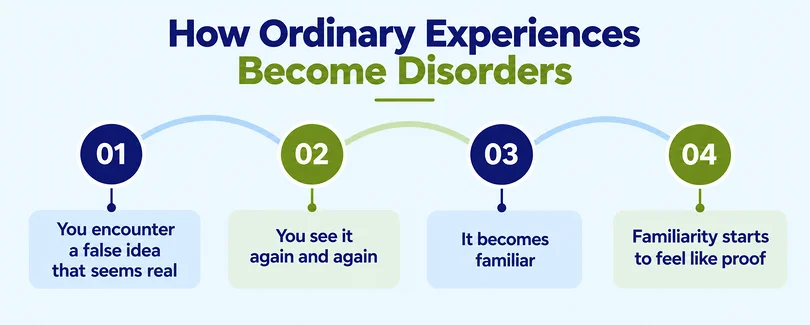
- You encounter a false idea that seems real
- You see it again and again
- It becomes familiar
- Familiarity starts to feel like proof
The person is still experiencing the same everyday distraction. The only thing that changes is how convincing the explanation feels because they have heard it so many times.
Is the Illusory Truth Effect a Mental Disorder?
No. The illusory truth effect is not a mental health disorder. It is a cognitive bias driven by processing fluency, the ease with which your brain processes familiar information, which it then misreads as a sign of truth.
None of this means you have a mental health disorder. It means your brain is doing what brains do, in a way that can mislead you when the same claim gets repeated often enough.
How Can the Illusory Truth Effect Lead to Mental Health Problems?
The illusory truth effect does not directly cause a mental health disorder, but it can lead to a condition that needs professional psychiatric care. It makes a repeated statement or idea feel true even when it is not. These similar thinking patterns occur alongside the following mental health conditions:
Depression
When you repeatedly think negatively about yourself. The thoughts feel like facts. Repeated criticism leads to low self-esteem, which leads to depressive disorder.
Anxiety
Anxiety involves the repeated worry about something bad happening. When this same thought appears again and again, the familiarity makes it more believable. This way, the thoughts feel real but do not make it a fact.
Obsessive-Compulsive Disorder (OCD)
People with OCD experience unwanted intrusive thoughts or fears. The repeated thoughts feel increasingly convincing. But an intrusive thought is not a prediction or proof that anything bad will happen.
These three conditions show how repetition can shape belief in different directions. A related concept works almost the same way but comes from a different source of confidence, which is called the illusion of validity.
Illusory Truth Effect vs. Illusion of Validity
Both concepts involve the same situation in which a person becomes more confident that something is true. But the reason for that confidence is different. The comparison is given in the table below:
| Aspect | Illusory Truth Effect | Illusion of Validity |
| What happens? | Repeated information starts to feel true. | Confidence in a judgment makes it feel accurate |
| Why? | Familiarity makes information easier to process. | Confidence in your judgment can be mistaken for evidence that the judgment is correct. |
| Simple example | I’ve heard this so many times, so it must be true. | I’m very sure about my conclusion, so I must be right. |
| Main issue | Repetition → familiarity → perceived truth | Confidence → perceived accuracy |
What Does Research Say About Repetition and Belief in Mental Health?
Repetition and false belief in psychological research are discussed in two different conditions mentioned below:
Schizophrenia and Delusion-Relevant Beliefs
A study byMoritz et al. (2012) found a stronger illusory truth effect for delusion-relevant statements among participants with more severe positive symptoms, with the strongest correlation found for delusion-specific symptoms. This finding does not mean the illusory truth effect causes schizophrenia. The researchers framed repetition as a possible factor in maintaining certain beliefs, not a cause of the condition itself.
OCD and the Cost of Ruminating on Intrusive Thoughts
A study of individuals diagnosed with OCD found that ruminating on obsessive-compulsive symptoms increased symptom severity. It also reduced positive affect over the following 24 hours, compared to ruminating about mood generally.According to research on rumination and intrusive thoughts, repeating a distressing thought, even mentally, can strengthen it rather than resolve it.
So, the takeaway is that the same bias that can help maintain rigid beliefs in clinical conditions also operates in everyday life but with far less extreme consequences.
Why Does Repetition Make Something Feel True?
When you see or hear something repeatedly, your brain becomes more familiar with it. As a result, the information becomes easier and faster to process. That’s why it feels more believable.
This shortcut is often helpful because familiar information is usually easier to remember. But it also misleads you when the repeated information is false.
How Does an Ordinary Experience Start to Feel Like a Disorder?
Symptoms start to feel like a diagnosis when everyday experiences are interpreted as signs of a mental health condition. For example, feeling unmotivated after a stressful week may seem like depression. This happens especially after reading online descriptions of depressive symptoms.
What Are the Consequences of the Illusory Truth Effect
The illusory truth effect contributes to:

- Inaccurate self-diagnosis
- Increased anxiety
- Delayed professional care
- Unnecessary self-treatment based on wrong advice
What Makes the Illusory Truth Effect Stronger?
A few of the following conditions make repeated claims stick more easily:
- The statement is simple and easy to understand
- It appears across many sources, even ones quoting each other
- It matches something you already believe or fear
- You’re stressed or emotionally upset
- The message is delivered with confidence or strong emotion
- You’ve forgotten where you originally heard it
Research shows that the more often people hear or see something, the more likely they are to believe it. They feel confident that it is true. According toHassan and Barber’s 2021 study, truth ratings climb as people encounter the same information repeatedly.
How Does Social Media Combine Illusory Truth Effect With Mental Health Conditions?
Social media platforms give you repeated claims, headlines, and health information. So, when you repeatedly see the same information, it will feel more believable. Even when the information lacks any reliable evidence. Doomscrolling makes the illusory truth effect more noticeable. That’s why if an individual is already worried about their health, repeated exposure increases anxiety and other related mental health conditions.
How Does Inland Empire Behavioral Group Treat Conditions Linked to the Illusory Truth Effect?
Our treatment is focused on anxiety, depression, and other mental health conditions that get worse with repeated thoughts. With Cognitive Behavioral Therapy (CBT), our licensed providers help build metacognitive skills that you apply to the specific thoughts causing distress, such as:
Anxiety: CBT helps you test a feared thought against the actual evidence instead of how often you’ve seen it.
Depression: cognitive behavioral therapy works through repeated negative thoughts until you can tell the familiar from the accurate.
OCD: CBT helps you break the cycle where ruminating on an intrusive thought makes the illusory truth effect stronger instead of resolving it.
Has the Illusory Truth Effect Made OCD, Anxiety, or Depression Feel Like a Match? Get Clarity
Inland Empire Behavioral Group provides accurate evaluations. Here, you talk with a licensed mental health provider about your history, your symptoms, and how they affect your days. We look at how often, how severely, and in which situations they happen, and what else could explain them. You leave with a clear answer and a personalized plan that fits you.
Our team offers evidence-based care that includes cognitive behavioral therapy, which tests a belief against real evidence. Get in-person sessions and telehealth options in Riverside and Colton, CA.We accept major insurance plans.
⊕REFERENCES
- Hassan, A., & Barber, S. J. (2021). The Effects of Repetition Frequency on the Illusory Truth Effect. Cognitive Research: Principles and Implications, 6. https://doi.org/10.1186/s41235-021-00301-5
- Steffen, M., Köther, U., Woodward, T. S., Veckenstedt, R., Dechêne, A., & Christoph, S. (2012). Repetition is good? An Internet trial on the illusory truth effect in schizophrenia and nonclinical participants. Journal of Behavior Therapy and Experimental Psychiatry, 43(4), 1058–1063. https://doi.org/10.1016/j.jbtep.2012.04.004
- Wahl, K., van den Hout, M., Heinzel, C. V., Kollárik, M., Meyer, A., Benoy, C., Berberich, G., Domschke, K., Gloster, A., Gradwohl, G., Hofecker, M., Jähne, A., Koch, S., Külz, A. K., Moggi, F., Poppe, C., Riedel, A., Rufer, M., Stierle, C., … Lieb, R. (2021). Rumination about obsessive symptoms and mood maintains obsessive-compulsive symptoms and depressed mood: An experimental study. Journal of Abnormal Psychology, 130(5), 435–442. https://doi.org/10.1037/abn0000677