
Anxiety is a mental health condition. It is a feeling of excessive fear, worry, or nervousness, mainly about upcoming events. For this, grounding techniques can be an effective way to instantly shift your mind from “what if” scenarios, “what will be,” catastrophic thinking, to “here” and “now”. This resets the thoughts running in your mind and all the bad emotions you feel.
In this blog post, we will learn about 16 highly effective grounding techniques for anxiety. Also, we discuss how these anxiety-relief exercises can help you find relief, stay present, and calm your nervous system. Let’s start!
What Are Grounding Techniques?
Grounding techniques are a combination of physical, psychological, and soothing exercises to bring your mind back to the present from negative, future-oriented thoughts.
How Grounding Techniques for Anxiety Actually Work?
In simple terms, anxiety is your excessive worry or nervousness about something that is unpredictable before any decision, such as going to an event, giving a presentation, or taking an exam. These feelings are like “what if I fail”, “get fired”, “can’t handle”, and more, depending on a person’s thinking patterns and personal circumstances.
Grounding techniques distract your brain from such thinking and force it to focus on the present and your surroundings. For instance, one common grounding technique is putting your hands in water. This technique immediately signals the brain and interrupts its “fight or flight” response. By forcing it to focus on:
- Sensation of the water (warm or cold)
- To such hand areas it touches (fingers, back, palm)
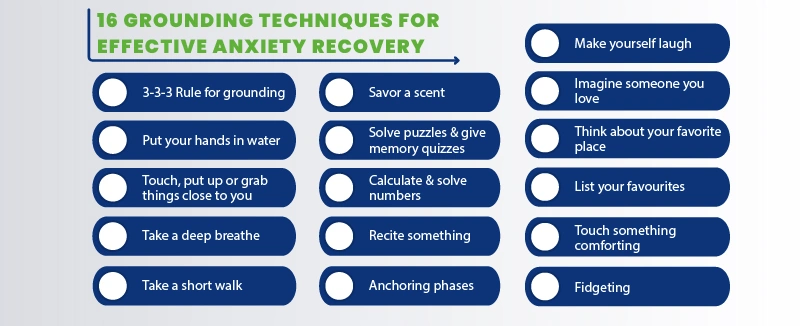
16 Grounding Techniques for Effective Anxiety Recovery
This section will be your center of attention, since this guide begins, right? In this blog section, we will discuss 15 highly effective ground techniques for anxiety. To avoid things getting messed up, we will group the techniques into 3 categories. Here, they are:
Physical Grounding Techniques
1. 3-3-3 Rule for Grounding
We see things, but often overlook them. We do not fully observe our surroundings. How much do you notice about your room when you wake up in the morning? We do not! This is called living on “auto-pilot”. However, actively noticing our mind shifts it from autopilot to presence. And this is used as a technique, named the 3-3-3 rule, for grounding for anxiety.
In this, you have to observe and feel things:
- 3 things you see
- 3 sounds you hear
- move 3 parts of your body
Maybe many of you are overwhelmed, but don’t overthink. Just take a look at your surroundings and answer what you see, hear, and which body part you moved.
2. Put Your Hands in Water
As we saw earlier, this technique is also very effective and delivers immediate relief. For this, fill the bowl with cold water. Put your finger into it, then palm, and later back, and pay close attention to the sensory experience. This relieves your mind of racing thoughts by drawing your attention to the sensation of water on your skin. You can also float your hand in water and hold an ice cube until it melts.
3. Touch, Put Up or Grab Things Close to You
Picking or touching things, could be anything closer to you, like the table edge, your wrist, or even putting your hand flat on the wall, can make you feel calm. Noticing factors like the thing you pick or touch is hard or soft, planned or uneven, and many other sensations. This helps make your brain live in the present, not worry excessively about unpredictable future events.
4. Take A Deep Breathe
Taking deep breaths can make you feel relaxed from anxious worries and fear. Sit straight and inhale air slowly through the nose and then exhale through the mouth. The best approach could be to place your hand on your chest and the other on your stomach. You can choose any of the two breathing techniques for this, including;
- 4-7-8 Breathing: Inhale for 4 seconds, hold for 7 seconds, and exhale little by little for 8 seconds
- Box Breathing: Inhale, hold, and exhale, each for 4 seconds
5. Take A Short Walk
Taking a short walk can help you reduce anxious thoughts and emotions. In addition to lowering cortisol levels, paying attention to your footsteps can help bring your brain back to the present. While walking, try counting each step you take, either aloud or in your mind. For example, as you walk a certain distance, count how many steps it takes to get there. You can also estimate how many steps you will need to cover a specific distance. This keeps your mind engaged and distracts you from persistent, fearful thoughts.
6. Savor A Scent
Scenting your favourite notes can help get a temporary relief from worsening anxious feelings. Savoring a scent you love, such as scented candles and soaps, activates the limbic system and helps reduce cortisol levels. This gives the brain instant relaxation. Further activity you can do is guessing fragrance notes, e.g., woody, citrusy, etc.
✓ Stress & Panic Management
✓Improved Mood & Resilience✓ Telehealth & In-Person Visits
✓ Most Major Insurances Accepted
Mental Grounding Techniques
7. Solve Puzzles & Give Memory Quizzes
To keep your brain free from negative thoughts, you can solve puzzles and play memory games. It’s pretty easy and surprisingly powerful. Grab a puzzle, place it in front of you, and try to solve it by placing scattered pieces precisely. Moreover, scan a photo for just a few seconds and then visualize the same image in your mind. It’s not about creating a precise imaginary image. Forget perfection for a second. What matters is keeping your brain busy and focused. Even considering the elements you noticed can be enough to keep your mind busy in collecting scenes, not in producing unnecessary thoughts.
8. Calculate & Solve Numbers
Solving difficulties, like numbers, can decrease your anxiety levels. You can pen down numbers, like any random one, even your phone number, add digits up, multiply them, and perform other calculations. It might feel boring, but terrific for your mental health. Plus, you can calculate all the expenses you make all day and play many other complex, yet fun, number games.
9. Recite Something
Imagine the song lyrics in your mind, vibe every line, and sing with a slight lip movement. You can follow these techniques while doing anything or at rest. It’s not mandatory that you have to recite a song. Think of a story, quote, poem, or anything you remember from memory.
10. Anchoring Phases
Try saying positive statements that make you feel calm and relaxed, even if you are not feeling well. Take a deep breath and try saying these affirmations, such as,” Today, the weather is pretty awesome, hopefully, it will be a better start to the day, “I’m safe,” “I can control my mind’s running thoughts”, etc.
11. Make Yourself Laugh
Making yourself laugh can help you relax your nervous system. Also, our physiological and physical well-being are interconnected; keeping your mood happy breaks the negative thoughts cycle. For this, you can try to remember funny jokes in your mind. Plus, you can also take help from today’s digital world, such as watching entertaining, funny videos.
Soothing Grounding Strategies to Calm Anxiety
12. Imagine Someone You Love
Thinking about someone you love or someone you know who helped you in difficult situations, or in any way has a positive impact on your life, is the best way to calm down. Imagining his/her face or even vibrating their voices can slow down your mind overwhelmed by negative thoughts, and can help bring a smile to your face.
13. Think About Your Favorite Place
Imagine a place you love, one you have visited, are planning to see, or simply wish. Visualize that unique setting, give your expectations an illusion of being actually there, and embrace the sensation. This gives you relief from inner anxiety and takes you to the world of imagination, calming your nervous system.
14. List Your Favourites
Consider it like a fun game and list 5 things you like by categorizing them in food, books, songs, places, and movies, in each. Think for a second, pen them down, and as per your mood, make implementation. Want something to eat? Cook your favourite food. Sitting leisurely? Pick your favourite book and dive into it from the heart.
15. Touch Something Comforting
Touch anything you like, such as a dress, and remember when you purchased it and what your expectations were at that moment. Doing this, visualize the complete story in your mind, and help reduce anxious thoughts and needless nervousness.
16. Fidgeting
Another best approach to keep your brain busy is to pick something closer to you. It could be anything like door keys, a book, etc., and try focusing on their pattern, shape, and start guessing their weight. For something like a book, you can count pages by giving yourself a challenge to complete within a specific time.
Does Grounding Exercises Really Work for Anxiety?
Yes! Grounding techniques are exceptionally helpful for people experiencing anxiety disorders and panic attacks. Immediately refocusing on real-world things calms the nervous system and maximizes mental clarity.
People’s Shared Experience on Anxiety Grounding Techniques
However, to reassure you that you are not alone, and to clarify to you that the grounding really works for anxiety. Here are some Reddit users’ experiences they shared online:
Based on our research on people’s engagement with grounding skills for anxiety, we have noticed that people have experienced or are experiencing impressive outcomes. Well, it’s not like these exercises create a win-win situation for everyone, but for many, they do.
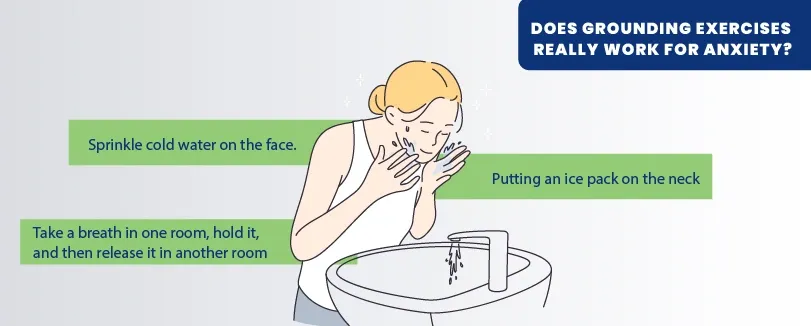
For some, they won’t work, partially for some, while the rest notice a significant reward. Some of them shared their go-to grounding exercises for panic attacks, like:
- Sprinkle cold water on the face.
- Putting an ice pack on the neck
- Take a breath in one room, hold it, and then release it in another room
How Can Inland Empire Behavioral Group Help?
Inland Empire Behavioral Group is a trusted and most preferred destination for people searching for quality mental health services in California. Backed by the trust of thousands of patients, we have been offering mental well-being services for over 15 years.
With the adoption of modern, advanced psychiatric services and the expertise of certified psychiatrists and psychiatric-mental health nurse practitioners (PMHNPs), we help patients of all ages, children, adolescents, and adults to live a mindful, purposeful, healthier life.
At Inland Empire Behavioral Group, our approach is not just to offer services, but to ensure patients’ mental wellness with the right treatment and lasting expert support. Further, you can visit our clinic or connect with us through our telehealth services.
Conclusion
The grounding techniques for anxiety are the strategies or skills that interrupt your brain’s thinking and behavioral patterns. It helps instantly shift the brain’s attention from fearful, nervous, future-related worries to force refocusing on the real world.
Practicing the above-discussed grounding tips for anxiety can help you turn your inner anxiety into instant reality. You can practice them for at least 10 minutes a day by combining them, or practice each individually every day.
We hope this guide helps you. Don’t overthink, start practicing from today, and begin your journey to a healthy, mindful life. If you have any questions, contact us without any hesitation. We are here to help you!