
Cyclothymic disorder or cyclothymia is a chronic, anonymous mental health condition. It has emotional feelings, categorized as ups (hypomanic) and downs (mild depression). Meaning, cyclothymia affected people sometimes at the peak of the world and instantly at rock bottom. Passing through such a condition, starting from extreme happiness and satisfaction, to a rapid ending at sadness and low self-esteem, cyclothymic disorder affects an individual’s life significantly.
In today’s guide, we will discuss all about cyclothymic disorder. It includes symptoms, causes, its relation to other mental illnesses, bipolar I and II, and treatments for management.
What is Cyclothymic Disorder OR Cyclothymia?
Cyclothymic disorder is a persistent mood swing due to episodes of hypomania and mild depression. In simple terms, it causes frequent changes in people’s mood, energy, and thinking patterns. This mental health condition is chronic and can last for at least 2 years.
How Common is Cyclothymic Disorder?
Cyclothymia disorder is not as common as major depressive disorder and anxiety disorder. Also, in relation, it is less common than bipolar disorder I and II.
Research indicates that around 0.4% to 1% of the U.S. population is affected. Its rarity hides two major, worsening concerns. One is that cyclothymia is commonly found in adolescence. Another is that it can be underdiagnosed.
The term “common” refers to the diagnosis ratio of cyclothymia among people. Researchers believe the prevalence of cyclothymic disorder may exceed the ratio if diagnostic recognition improves and greater clinical attention is given. Because cyclothymic disorder, the disorder with depression and hypomania, shows similar signs to other mental illnesses like bipolar disorder II. This causes overlap with other psychological conditions.
Is Cyclothymia Bipolar Disorder?
People experiencing cyclothymic disorder have close to bipolar disorder-like symptoms. These include mood swings, energy fluctuation, and more due to the simultaneous involvement of hypomanic and mild depression episodes. The differentiating factors are episode intensity and duration. That’s why cyclothymia can be classified as a mild form of bipolar disorder (Bipolar III disorder). But the symptoms are not as severe as those of bipolar disorders I and II.
Symptoms of Cyclothymic Bipolar Disorder
Being cyclothymic, you can experience unpredictable episodes of hypomania and depression. Meaning, experience one disorder (cyclothymia), you probably have two conditions (hypomania and mild depression). Based on this, the symptoms differ when undergoing each condition. In the up phase of cyclothymia, you have signs of hypomania, while in the low phase, of course, the signs of depression are noticed.
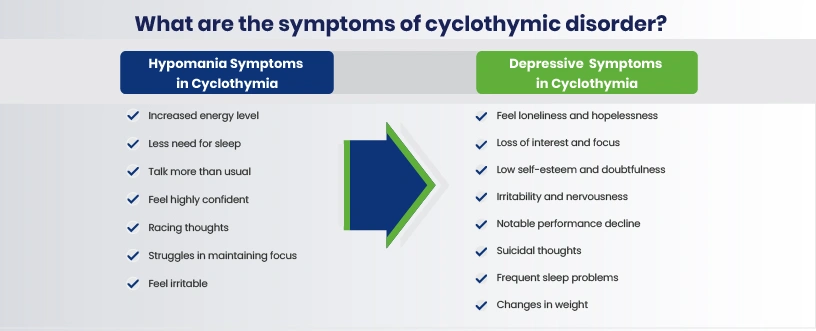
Here’s how it feels in each phase of the condition:
Hypomania Symptoms in Cyclothymia
Hypomania is one of two mental conditions whose episodes frequently occur in cyclothymic disorder. In this condition, you feel extremely happy. Engage in a task with confidence and high energy levels, and show self-abandonment. Such feelings are not related to how you normally feel, act, and behave, because no specific event happens in life that feels rewarded. They are fully unpredictable and occur for no reason.
Here are the symptoms of hypomania in cyclothymia:
- Increased energy level
- Less need for sleep
- Talk more than usual
- Feel highly confident
- Racing thoughts
- Struggles in maintaining focus
- Feel irritable
Depressive Symptoms in Cyclothymia
Depressive symptoms are fully opposed to symptoms you can experience during hypomanic episodes. Swinging mood to mild depression often shows signs of sadness, feeling lonely, loss of interest, and energy, which means a sudden transit from on top of a mountain to at rock bottom.
Below are some of the signs of depressive symptoms in cyclothymic disorder:
- Feel loneliness and hopelessness
- Loss of interest and focus
- Low self-esteem and doubtfulness
- Irritability and nervousness
- Notable performance decline
- Suicidal thoughts
- Frequent sleep problems
- Changes in weight
Experiencing cyclothymic disorder, you can experience such signs during frequent cycles of hypomania and mild depression. However, the symptoms are not severe; their intensity ranges from mild to moderate. But the persistent changes in mood types overwhelm the brain and can cause major psychological and physical illnesses.
✓ Support for Personality & Behavioral Concerns
✓Improved Self-Awareness✓ Telehealth & In-Person Visits
✓ Most Major Insurances Accepted
Causes of Cyclothymic Disorder
Cyclothymic disorder is anonymous. The exact cause behind the development of cyclic highs and lows has not been identified. However, researchers believe it can be a multifactorial condition. Like other mental health illnesses, the factors discussed below can contribute to the progression of cyclothymic disorder.
- Genetics: In the development of cyclothymic disorder, genetics can have a major involvement. It increases your chances of undergoing such conditions if your first-degree relative is already struggling.
- Brain Biology: Imbalance in the brain neurology, like how it thinks and functions, can also be a contributing factor in the case of cyclothymic disorder.
- Environmental Stress: Traumatic life experiences and passing through life’s most difficult situations from any aspect, health, financial, or more, can cause cyclothymia.
No single factor alone can cause mild bipolar disorder. Instead, it’s a result of a combination of these factors or more. This significantly affects an individual’s psychological health.
Risk Factors Caused by Cyclothymic Disorder
Cyclothymic tendencies can make it very hard for a person to do everyday things. Mood cycles, lasting two years, can lead to risky situations. It affects the way the brain thinks, the ability to make decisions, and more.
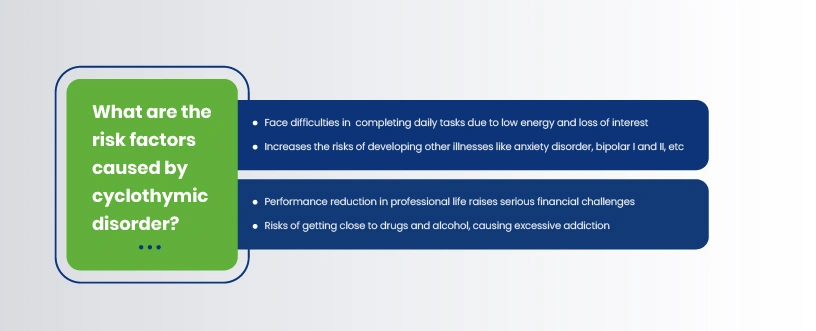
Racing thoughts cause unorganized thinking, which raises several challenges in an individual’s life, including social and relationship issues. Here are some of the risk factors of cyclothymic disorder:
- Face difficulties in completing daily tasks due to low energy and loss of interest
- Increases the risks of developing other illnesses like anxiety disorder, bipolar I and II, etc
- Performance reduction in professional life raises serious financial challenges
- Risks of getting close to drugs and alcohol, causing excessive addiction
Treatment For Cyclothymic Disorder
Like many other mental illnesses, cyclothymic disorder is also treatable. Treatment helps reduce symptoms and lower intensity. People who undergo treatment observe exceptional outcomes, noticing significant mood stability and improvement.
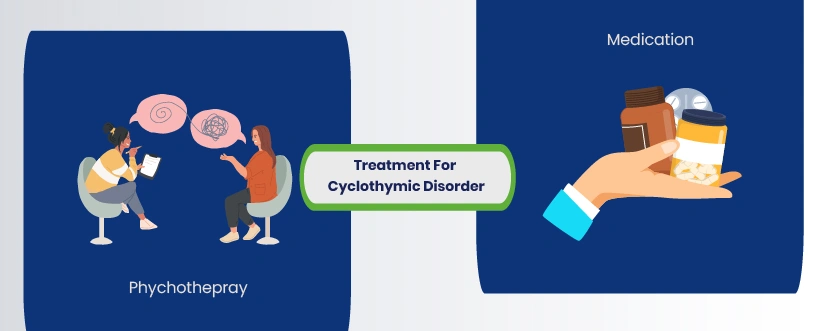
Here are some of the treatment approaches for effectively treating cyclothymic disorder:
- Psychotherapy
- Medication
Psychotherapy
Psychotherapy is a treatment approach for improving mental wellness. Often referred to as “talk therapy,” it is a form of communication between patients and psychiatrists, but in a clinical setting. It focuses on diagnosing, evaluating, and replacing unhealthy thoughts and emotions to ensure mental wellness.
Talk therapy or psychotherapy is a collection term. Meaning, it’s a treatment technique or method and acts as an umbrella, covering several types of therapeutic treatments. Such types are widely recognized in treating psychological conditions.
However, talking specifically about cyclothymic disorder, some psychotherapy or psychological counseling treatment types show great success. These include:
- Cognitive Behavioral Therapy (CBT)
- Interpersonal and Social Rhythm Therapy (IPSRT)
- Specialized therapies
Cognitive Behavioral Therapy (CBT)
It can be one of the most effective treatments for cyclothymic disorder. CBT, short for Cognitive Behavioral Therapy, is focused on three main factors, including identifying, understanding, and replacing unhealthy thoughts and emotions.
The psychiatrist’s approach in the treatment process is to improve cognitive control and build positive beliefs. This goal is gradually achieved throughout the treatment, restoring the mind’s ability to effectively regulate thoughts and emotions that contribute to cyclic highs and lows.
The process starts with initial assessments to discuss and design a treatment plan. Moving forward, the treatment breaks into individual or family sessions, personalized to the person’s condition. These sessions provide patients with a non-judgmental space, helping them understand their feelings and deliver support. This collaborative approach helps reduce low-grade mood fluctuations and lower the frequency of ups and downs.
In short, CBT is safe and highly effective in mood stabilization. Further, you can read the 51-week study on a cyclothymic patient who received CBT.
Interpersonal and Social Rhythm Therapy (IPSRT)
This therapy is recognized to treat mental health conditions, mainly bipolar disorder. Cyclothymic disorder, as a mild form of bipolar disorder, people experiencing such conditions can also benefit from IPSRT.
Interpersonal and social rhythm therapy is based on building healthy habits that can improve mood regulation. It includes stabilizing daily life activities like walking, sleeping, and eating. Scheduling and implementing these activities regularly helps improve mood, as well as appears effective in reducing relapse.
Dialectical Behavior Therapy (DBT)
Aside from CBT and IPSRT, Dialectical Behavior Therapy helps reduce and manage episodes of hypomania and depression. DBT therapy focuses on emotional regulation and mindfulness.
Medication
Medication can also help reduce ups and downs in mood cycles, and can be considered as a secondary treatment approach. However, it is important to understand that no specific medication for cyclothymic disorder officially exists, nor is any approved by the U.S. Food and Drug Administration (FDA).
However, in some cases, psychiatrists often prescribe medication to continue alongside treatment. It is fully based on an individual’s conditions. Always clarify dosage, duration, as well as ask for side effects from your mental healthcare professional to avoid misconceptions and prevent risks
Don’t take any mood stabilization medication labeled as the best medication for cyclothymia. Cyclothymia can be treated without medication with treatment approaches like CBT. Consult with your health partner for valuable guidance.
Major Barrier People Face Before Getting Treatment
The only barrier people mostly face in getting the treatment is overlapping symptoms. This silently worsens the condition, damaging the brain. Often used simultaneously with bipolar disorder, cyclothymic disorder symptoms are confusing, sometimes misdiagnosed, resulting in improper treatment.
It is highly recommended to consult with a certified mental healthcare professional for a proper cyclothymic disorder diagnosis. Doing this is crucial before making any treatment decision.
Misdiagnosis not only worsens the condition but also delays it, if it sounds familiar. You don’t have to worry, treatment is like an outfit, some find it earlier, while others find the best one after too many selections. No matter how delayed you are in receiving the right treatment, there is always hope. Consult a psychiatrist for diagnosis and personalized treatment.
How Can Inland Empire Behavioral Group Help Patients with Cyclothymic Disorder?
Inland Empire Behavioral Group is a trusted mental health care service provider in California offering treatment for cyclothymic disorder. We aim to deliver to every patient the quality of life they deserve through the right mental health treatment and care.
Our team of certified psychiatrists makes every visit a step closer to your mental wellness. From initial assessments to ongoing treatment and recovery, we remain attentive and deliver support with treatment to patients in every stage.
We offer fully personalized treatment approaches based on your mental conditions and evaluation. This ensures every patient receives the right treatment. Moreover, we track progress periodically to measure treatment effectiveness and make changes accordingly.
Although cyclothymic disorder is a lifelong condition, it requires a long-term treatment process and support. At Inland Empire Behavioral Group, we commit to delivering both to help patients continue living a purposeful, happy life. There is still time, and hope exists. If you are noticing cyclothymic symptoms, call us today. Our certified psychiatrists help overcome such conditions.