
Have you ever met someone who seemed charming, confident, and assertive, but later turned out to be manipulative?
If yes, then you might have encountered the dark triad.
The term “dark triad” was coined by Delroy L. Paulhus and Kevin M. Williams in 2002. It’s a psychological theory of personality that refers to three negative personality traits named narcissism, psychopathy, and machiavellianism. These traits are considered “dark” because they often involve manipulative or cruel behavior.
Psychopathy is marked by a lack of empathy and emotional depth, narcissism by excessive self-love, and Machiavellianism by manipulation. Each of these personalities is different from the others, but also overlaps, and is considered dark.
People with these tendencies are manipulative, emotionally cold, selfish, and use people for their own benefit. They are masked with charming and charismatic characters and severely exploit their family, loved ones, and even colleagues. They can be incredibly duplicitous and aggressive.
Understanding this can help people to know if they are experiencing this condition, and or to avoid or escape from a toxic relationship.
What Are Dark Traits?
The term dark triad is associated with three personality traits named narcissism, machiavellianism, and psychopathy. These three personality traits are generally associated with negative human behaviors.
Individuals with dark triad traits rank high in their readiness to exploit anyone. They experience no guilt when they inflict harm on others. These traits are associated with a callous, manipulative interpersonal style.
The Three Pillars of the Dark Traits
Individuals with the dark triad of personality traits are probably impulsive and engage in risky behaviors that often lead to severe consequences. However, in severe cases, people in this state may even commit acts of crime, and they don’t even feel bad about it.
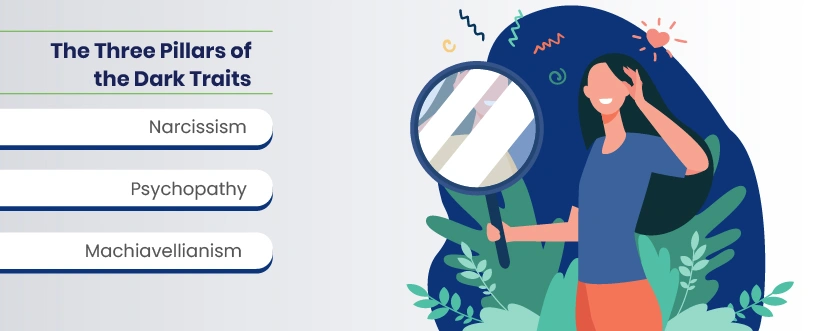
People with high-score personality traits are less compassionate, remain in an overinflated sense of self, and are often shameless when it comes to self-bragging. Here are the three personality traits that can be considered to be dark triads.
1. Psychopathy
Psychopathy is the first element of the dark triad. A true psychopath is someone who exhibits antisocial behaviors. People in this state lack empathy and are unable to put themselves in other people’s shoes. Individuals experiencing this state often can be bold and impulsive and act in ways that cause harm to others without any guilt. They are often more inclined toward negative, antisocial, and criminal behavior.
Moreover, their actions are often compelled by a desire to get power and control. Psychopathy is not a mental health diagnosis in the DSM criteria. Although its closest equivalent is antisocial personality disorder. There is also another term named subclinical psychopath who may exhibit the same behaviors, but the effects are lower compared to psychopathy.
2. Narcissism
Narcissism is a common personality trait among the three dark triads.
It derives from the Greek mythology tale of Narcissus, in which a hunter fell in love with himself, & became obsessed with his reflection by looking at the pond of water and eventually drowned.
What are the characteristics of Narcissism?
People in this condition exhibit selfish behavior, arrogance, lack empathy, boastfulness, and are sensitive to criticism and use people for their own benefit. Narcissism leaves one to become self-centred; they believe they are special. However, narcissists often have difficulty managing relationships with others, as it requires taking care of someone’s needs outside of their own. They remain entitled and superior because they are masking their typical sense of inadequacy.
Moreover, individuals with narcissistic tendencies need lots of attention, affirmation, and praise from others. And if they don’t get it, they can impose physical and emotional harm on the other person. People with narcissistic personality are also prone to stealing credit from others and are very self-centered.
3. Machiavellianism
The term Machiavellianism originates from the famous Niccolo Machiavelli, a politician and diplomat from Italy. Machiavellianism leads to mock values deeply. Individuals use behaviors like flattery and lies to exploit those around them. They have a tendency to lie, manipulate, act in self-interest, lack emotion, and show a lack of morality to gain power over others. It causes severe issues in maintaining relationships. Essentially, they are highly manipulative, and they ruthlessly deceive others to obtain what they desire. While they have a genuinely negative view of the world. Machiavellianism is not a mental health disorder itself, but it leads to certain mental health disorders.
Dark Triad Personality Traits
Individuals with dark triad traits usually hide their true selves to gain the trust of others rather than exploit it. They might act aggressively out of self-interest and lack empathy or guilt.
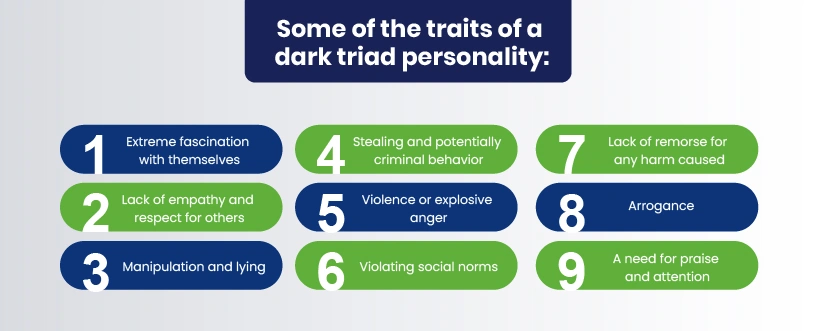
Here are some of the traits of a dark triad personality:
- Extreme fascination with themselves
- Lack of empathy and respect for others
- A history of being a victim, this usually occurs with narcissistic tendencies, as they gaslight others when their self-esteem is threatened.
- They express disappointment and are never satisfied
- A preoccupation with obtaining power by any means
- Manipulation and lying
- Stealing and potentially criminal behavior
- Violence or explosive anger
- Violating social norms
- Lack of remorse for any harm caused
- Arrogance
- A need for praise and attention
- Unable to maintain relationships with friends, family, and colleagues.
- Someone with dark triad traits may manipulate others for their benefit.
As per the research by the National Institute of Medicine, men might score higher on the dark triad scale than women. This difference is because of overt antisocial behavior associated with psychopathy, which suggests that it may be due to natural factors, such as testosterone and social norms.
Do Dark Triad Personalities Naturally Hide Their True Nature?
Yes, people with dark triad traits are naturally and deliberately hiding their true nature when meeting new people. All of these terms have overlapping symptoms, yet they are all different. People who exhibit these traits usually hide them; even when a person meets them for the first time, they are unable to recognize that they have a trio of attributes.
However, people with these traits mask their true nature. Recognizing someone with a dark triad personality is difficult, as they are charismatic and charming. Also, they are flatteries that make a person feel like they’re the best.
Therefore, when time passes by, individuals with the dark triad personality cannot continue to sustain this perception. Ultimately, they end their relationships in a blaze, where they result in manipulating the people they became close to, and by betraying their trust.
Dark Triad Personality Examples
- Example 1: People who have narcissistic tendencies can often seem charming at first meetings. However, it is just because of the perception that they have raised self-esteem.
- Example 2: A person with Machiavellianism spread a false rumor to destroy the reputation of an individual. It is because he wanted to get a benefit from it and secure a promotion. These kinds of people treat relationships only as tools for their own benefit.
- Example 3: A woman with narcissism reported that her partner was charming at the start, but after some time, she felt isolated. As her partner tries to control her, manipulate her, and even makes her feel guilty.
This is all because they remain in masks at the start, but after some time, their true colors show up.
What Are the Causes of the Dark Triad?
Dark Triad traits usually stem from combined genetic and environmental factors. Individuals are born with the tendency to develop narcissism, psychopathy, and Machiavellianism. However, the environmental factors play a major role; if an individual is living in a healthy environment, it can be controlled. As the involvement of parents and caregivers appears to play a role in dark triad personality traits, these behaviors occur from early childhood experiences.
Moreover, genes also play a major role in the development of dark traits, as these conditions run in families. Means if any close family member has been through dark triad personality traits, there is a high chance that you may also develop them. Though this component is much more significant for psychopathy and narcissism than for Machiavellianism.
As per the research, consistently harsh or unstable parent-child relationships often lead to insecurities related to attachment. However, it can be a contributing factor to these personality traits. However, children also exhibit these conditions in environmental situations. If they see their parents lying, neglecting their partners, they would consider this behavior in their adulthood.
✓ Support for Personality & Behavioral Concerns
✓Improved Self-Awareness✓ Telehealth & In-Person Visits
✓ Most Major Insurances Accepted
How Dark Triad Personality Traits Can Impact Life?
People who are experiencing the damaging trio of traits face severe consequences in managing life. It is because they remain in the cycle of abuse and gaslighting, and making others question their own willpower. It negatively impacts work and other important tasks. However, it can also be related to forms of organizational commitment. They lie about their commitments, including engaging in tasks and duties. They bully others in the workplace and make them guilty even for things for which they are right. They follow these tendencies in order to gain power and control over their colleagues and friends. People in this state use other weaknesses where they feel like they can benefit. They shatter the morals and lie with confidence.
Moreover, it severely affects the personal relationships with friends, family, and partners. They become controlling and make the other person feel like a puppet. As stated before, people with the dark triad personality are pros at manipulating facts and history for their own benefit. But over time, they are unable to sustain their perfect image.
How to Diagnose Dark Triad?
Dark triad is not a personality disorder nor a mental health condition. It is not listed in DSM 5, but it can be diagnosed by a mental health professional, as they can better understand where the patient falls on the spectrum of personality traits.
There are some tests for all three of the dark triad traits. It can be general personality questionnaires to get to know the strengths of these traits. There are also tests specifically designed to measure dark triad traits, such as the Short Dark Triad (SD3) and the Dirty Dozen (DD).
Note: If you think you or someone you know has a dark triad personality, reach out to a trained mental health professional immediately. They can accurately analyze the condition and recommend treatments.
Treatment Approaches
It’s very tiring to live with these personality traits. However, it is manageable with the right combination of medication and therapies. A mental health professional recommends treatments as per the severity of the condition.
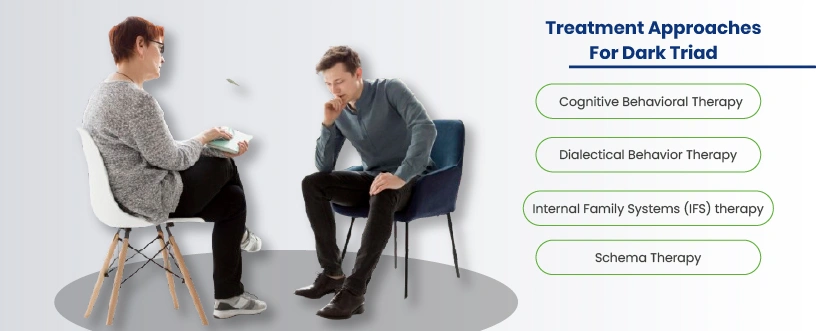
Here are some of the common therapies that can be helpful:
Cognitive Behavioral Therapy (CBT)
CBT is an evidence-based therapy that helps in changing thought patterns. A mental health professional helps the individual realise that their thoughts are not healthy, but intervenes in their thoughts. In this way, they change their manipulative or self-centered viewpoints, which disrupt and lead to harmful behavioral loops.
Dialectical Behavior Therapy (DBT)
DBT is really helpful in managing emotional regulation. It helps with the psychopathy and impulsivity elements. People in this therapy learn how to tolerate distress and interpersonal effectiveness. It is based on the idea that two opposing things can co-exist. In therapy, it means that one can accept their thoughts and emotions and still move on from them by changing them into productive thoughts and emotions.
Schema Therapy
This therapy helps by targeting deep-rooted, emotional schemas. It helps in reducing strong beliefs, such as people around are dangerous, life partners are always disloyal, people are cruel, so I should exploit everyone, so they cannot. All these beliefs are often formed during childhood.
Internal Family Systems (IFS) therapy
This therapy involves the family members in the therapeutic process. It helps in managing old childhood scars and helps individuals to overcome the different parts of trauma. The main goal of this therapy is to find the exiled parts and reconnect with oneself.
Get Help at Inland Empire Behavioral Group
If you feel like you or anyone you care about is experiencing dark triad personality traits. Getting help is not a sign of weakness.
At Inland Empire Behavioral Group, we have a team of certified professionals who offer compassionate, evidence-based treatments by carefully examining your condition. Our expert psychiatrists can understand all major or minor personality disorder symptoms and can suggest changes and holistic treatment options. You can also get virtual treatments through our telepsychiatric option. We adjust care to fit your symptoms, life situation, and goals.
Call us or send us an email to book an appointment.