
A narcissist and a sociopath are not the same, although people often use the terms interchangeably. Narcissistic personality disorder is built around grandiosity and a fragile need for admiration. However, Antisocial personality disorder (ASPD) is the clinical term behind “sociopath”. It’s built around a pattern of ignoring the rights of other people, lying, and feeling little remorse about it. Both of these mental health conditions are mentioned in the DSM-5-TR, the manual the American Psychiatric Association uses to define personality disorders. But they play out differently in real life.
Narcissist vs Sociopath at a Glance
| Feature | Narcissistic Personality Disorder (NPD) | Antisocial Personality Disorder (ASPD) |
| Core drive | Need for admiration, validation, and recognition | Personal gain, control, or disregard for others |
| Empathy | Reduced empathy, though some capacity remains | Limited or absent concern for others’ rights and feelings |
| Remorse | Can be limited, particularly when behavior threatens self-image | Limited or absent |
| Behavior pattern | Grandiosity, entitlement, need for admiration, and exploitation | Deceit, impulsivity, aggression, and repeated rule-breaking |
| Underlying pattern | Vulnerable self-esteem often protected by grandiosity and a need for validation | Persistent disregard for others’ rights, linked to behavior problems that started in childhood or adolescence. |
| Typical onset | Patterns typically become evident by adolescence or early adulthood | Evidence of conduct disorder before age 15 is required for diagnosis |
| DSM-5-TR code | F60.81 | F60.2 |
What Similarities Do Narcissists and Sociopaths Share?
Narcissists and sociopaths share enough symptoms that it’s easy for people to mix them. They share a core lack of empathy and have a tendency to manipulate others for personal gain. An epidemiological study found that NPD consistently co-occurs with antisocial personality disorder more than expected by chance. This is another reason misdiagnosis often happens. The shared characteristics of both conditions include the following:
- Both come across as charming or charismatic at first
- Struggle to sustain long-term relationships
- They externalize blame instead of taking responsibility
- Can manipulate through lying, flattery, or intimidation
- Expect loyalty from those around them without returning the same
That’s why they are called Narcissistic Sociopaths. They share significant characteristics of both NPD and ASPD. A person combines the grandiosity and need for admiration you’d see in narcissism with the deceit and disregard for others’ rights that define antisocial personality disorder. Clinicians sometimes call this combined presentation malignant narcissism, a term Otto Kernberg used for narcissism fused with antisocial behavior and paranoia.
What Is Narcissistic Personality Disorder (NPD)?
NPD is a personality disorder defined by grandiosity, a persistent need for attention, and lack of empathy that begins in early adulthood and shows up across multiple areas of life. Although under this grandiosity, there is real insecurity.
According to research, NPD is linked to unstable self-esteem and difficulty managing emotions. A person may appear overly confident as a way to protect a fragile sense of self-worth that is easily hurt.
What Factors Contribute to Narcissistic Personality Disorder?
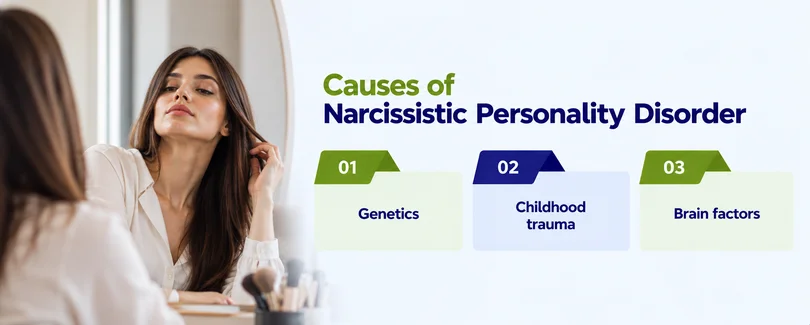
Nobody exactly knows what causes NPD, but according to a study, a mix of complex factors plays a role in causing this condition. They include the following:
- Inherited traits and a family history of personality disorder increase the risk.
- Parent-child relationships with extreme adoration or criticism can shape the condition
- Childhood experiences like trauma, abuse, negligence, or rejection can play a role in building fragile self-esteem.
- Parenting styles such as overprotectiveness or cold responses also play a role
- Neurobiological causes due to differences in how the brain regulates thinking and behaviors
What Is a Sociopath (Antisocial Personality Disorder)?
It is a mental health condition that shows repeated patterns of violating other people’s rights, including deceit, impulsivity, aggression, and a lack of remorse that traces back to conduct problems before age 15. Antisocial Personality Disorder is a clinically diagnosed term.
Why Do People With ASPD Behave the Way They Do?
The exact causes are also not fully known. But research on antisocial personality disorder shows that it is possibly caused by the combination of the following factors:
- According to a 2019 study, genetic factors may contribute to 38% to 69% of the risk for ASPD. It has also been found that the genes involved in antisocial personality disorder impact other body systems, including the dopamine system, serotonin system, and epinephrine system.
- Environmental factors such as childhood trauma and family disruption also play a role.
- It can be caused by co-occurring conditions such as depression, substance use disorders, or anger issues.
How Do Narcissist and Sociopath Symptoms Differ?
| Symptom Category | Narcissistic Personality Disorder (NPD) | Antisocial Personality Disorder (ASPD) |
| Self-view | Has an exaggerated sense of importance, talent, or status | May appear confident but has little concern for others’ opinions |
| Need for admiration | Strong need for praise, recognition, and attention | Does not typically seek admiration, focuses more on personal gain |
| Entitlement | Expects special treatment and compliance from others | Ignores rules and feels little obligation to respect others’ rights |
| Relationships | Uses relationships to support their self-image or goals | Uses relationships for personal benefit with little emotional attachment |
| Honesty | Exaggerates or distorts facts to protect their self-image | Repeatedly lies, deceives, cons, or uses false identities for personal gain |
| Reaction to criticism | Can become angry, defensive, or dismissive when criticized | May respond with irritation, aggression, or indifference |
| Responsibility | Blame others when things go wrong | Repeatedly fail to meet work, financial, or other obligations |
Narcissist vs Sociopath Traits: Side-by-Side Comparison
The symptom list above explains how each disorder differs clinically. This table focuses on how those patterns may appear in everyday life. This is especially true when a person faces conflict, criticism, blame, or accountability.
| Trait | Narcissistic Personality Disorder (NPD) | Antisocial Personality Disorder (ASPD) |
| Reaction to being exposed | Respond with anger, shame, or defensiveness | Respond with denial, manipulation, or little visible concern |
| Response to conflict | Become defensive when their self-image is threatened | Become aggressive or use intimidation to get what they want |
| Response to criticism | Often takes criticism personally and may react strongly | Can dismiss criticism or respond with irritation |
| Emotional vulnerability | Can be sensitive to rejection, failure, or perceived disrespect | Typically shows less concern about rejection or others’ approval |
| Approach to confrontation | Focus on defending their reputation or proving themselves right | Focus on gaining an advantage or controlling the situation |
How to Treat NPD and ASPD?
The primary treatment for both of these conditions is psychotherapy instead of a pharmaceutical cure. Both conditions are a bit challenging to treat, as the individuals rarely believe their behavior is problematic. That’s why mental health care from a licensed psychiatrist can help you manage the symptoms.
Treatment for Narcissistic Personality Disorder
Psychiatrists use different types of psychotherapy: Cognitive Behavioral Therapy (CBT), Dialectical Behavior Therapy (DBT), metacognitive interpersonal theory, and transference-focused therapy. These therapy sessions help patients to cope with criticism and manage fragile self-esteem. However, medication is prescribed only if there is a co-occurring condition like anxiety, depression, or any other mental health disorder. Otherwise, there is no specific medication for NPD.
Treatment for Antisocial Personality Disorder
The treatment focuses on behavioral management and reducing aggression. It involves CBT and schema therapy that help individuals identify unhelpful thought patterns and manage them without feeling humiliated. Psychiatric providers prescribe certain medications like antipsychotics, antidepressants, or mood stabilizers to treat the co-occurring mood disorders.
Get Professional Support for NPD or ASPD at Inland Empire Behavioral Group
Whether you are experiencing narcissistic or antisocial traits or affected by these behaviors in someone close to you, professional support can help. Inland Empire Behavioral Group provides personalized mental health care to help you understand these patterns and build healthier relationships.
Are Sociopath and Psychopath the Same?
No. Although sociopath and psychopath are often used interchangeably, neither is an official DSM-5-TR diagnosis. Both terms fall under the antisocial personality disorder (ASPD). As a 2013 study explains, psychopathy has a more specific research-based meaning associated with profound deficits in empathy, guilt, and conscience. Sociopathy, by contrast, is used to describe antisocial behavior that may be influenced by environmental factors such as upbringing, social learning, belief systems, or brain injury.
From this perspective, a sociopathic person may still have some sense of right and wrong, although it may be distorted. Psychopathy, on the other hand, is often associated with greater and more lasting difficulties with emotions and relationships. The terms overlap considerably, So, they must be diagnosed by a professional mental health provider.
Is Borderline Personality Disorder (BPD) the Same as Narcissism?
No, borderline personality disorder is not the same as narcissistic personality disorder. They are different mental health disorders and belong to the group of Cluster B disorders.
BPD involves fear of abandonment, unstable relationships, and extreme mood swings. However, NPD relies on superiority and a need for admiration. Impulsive behavior is common in both; that’s why individuals often confuse them.
Get Help Understanding Narcissist vs. Sociopath Patterns with Inland Behavioral Group
Inland Empire Behavioral Group provides individual therapy, family therapy, and psychiatric evaluation for adults navigating high-conflict relationships and their emotional aftermath.
Our licensed providers offer in-person sessions and telehealth options for individuals in Riverside and Colton, CA. If you’re trying to make sense of a difficult relationship or want an evaluation for yourself or a loved one, reach out to schedule a first appointment and talk through what support looks like for your situation.
We are in-network with major insurance. Also accepting new patients. So, why delay mental health care anymore? Book an appointment today with us!