
Cognitive-behavioral therapy (CBT) and dialectical behavior therapy (DBT) are two forms of psychotherapy, also known as “talk therapy.” Both approaches involve working with a mental health professional to better understand the challenges you experience and to develop skills to manage them on your own.
Although CBT and DBT have many similarities, they have different areas of focus and may be more suitable for different mental health concerns. Both therapies are evidence-based practices that help to manage long-term mental health disorders.
However, the choice between CBT and DBT therapy often depends on the type of problem, the intensity of emotions, treatment goals, and individual needs.
Difference Between CBT and DBT
The main difference between CBT and DBT is their primary focus. CBT focuses more directly on identifying and changing unhelpful thoughts and behaviors. DBT includes these principles but places additional emphasis on emotional regulation, acceptance, mindfulness, distress tolerance, and relationships.
CBT often asks:
How are your thoughts influencing your feelings and behaviors?
DBT often asks:
How can you accept reality as it is while actively working to change it?
CBT Vs DBT: Key Differences
| Feature | CBT | DBT |
| Core focus | Thoughts and behaviors | Emotion regulation |
| Main approach | Change-focused | Acceptance and change |
| Components | Individual therapy and group therapy | Individual therapy, group training, and coaching |
| Skills | Cognitive restructuring and behavioral strategies | Mindfulness, distress tolerance, emotion regulation, and interpersonal effectiveness |
| Duration | Often 3–6 months | Often 6–12 months |
| Best for | Anxiety, OCD, insomnia, and excessive worry | Intense emotions, self-harm, and relationship difficulties |
Let’s discuss both therapies in detail:
What Is CBT?
The CBT stands for Cognitive Behavioral Therapy, a widely used form of psychotherapy that focuses on identifying and changing negative or unhelpful thought patterns and behavior. Judith S. Beck explains that the way you think about yourself, others, and the world can affect how you feel and behave.
For example, someone experiencing insomnia may work with a CBT therapist to examine what they think, feel, and do throughout the day that affects sleep. The therapist may recommend spending less time in bed or changing negative self-talk around sleep. These changes can improve sleep quality and reduce the time spent waiting to fall asleep.
Common CBT skills include:
- Cognitive restructuring
- Identifying and challenging thinking traps
- Behavioral activation
- Exposure
- Behavioral experiments
- Problem-solving
- Coping skills
- Activity scheduling
- Relaxation techniques
- Mindfulness exercises
How does CBT work?
CBT works through a structured process of analyzing the associations between thoughts, feelings, and behaviors.
First, the mental health professional identifies thoughts and core beliefs that may be contributing to difficult thinking patterns. The individual then learns to evaluate these thoughts objectively and develop more balanced perspectives.
At the same time, CBT focuses on changing behavioral patterns through structured exercises and real-world practice.
A typical CBT session may include:
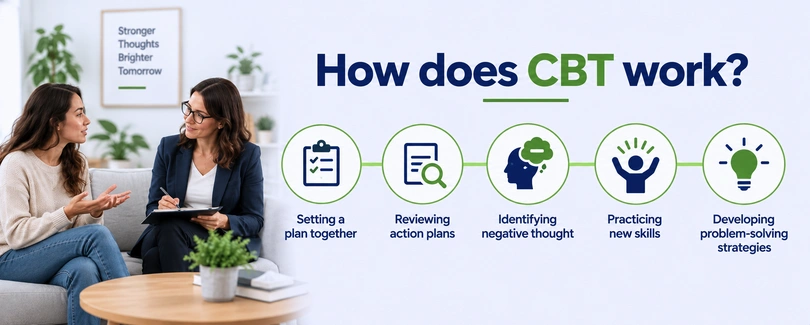
- Setting a plan together
- Reviewing action plans
- Identifying negative thought patterns
- Practicing new skills during the session
- Developing problem-solving strategies
- Assigning practice for the coming week
What Is DBT?
The term “dialectical” means the interaction of conflicting ideas. Within DBT, “dialectical” refers to the integration of both acceptance and change as necessities for improvement.
Dialectical Behavior Therapy is a specialized form of CBT with a greater focus on emotional regulation, acceptance, mindfulness, relationships, and distress tolerance.
“The fundamental dialectic in DBT is acceptance and change.”
— Marsha M. Linehan
DBT was originally designed to help people with BPD, self-harm or suicidal behaviors. DBT conceptualizes self-injury as a functional, although maladaptive, way to cope with painful emotional states. DBT teaches individuals that their experiences are real while also helping them develop healthier ways to respond to difficult emotions and situations.
How Does DBT Work?
DBT builds upon CBT principles but places greater emphasis on emotional and social dimensions.
It helps people learn how to:
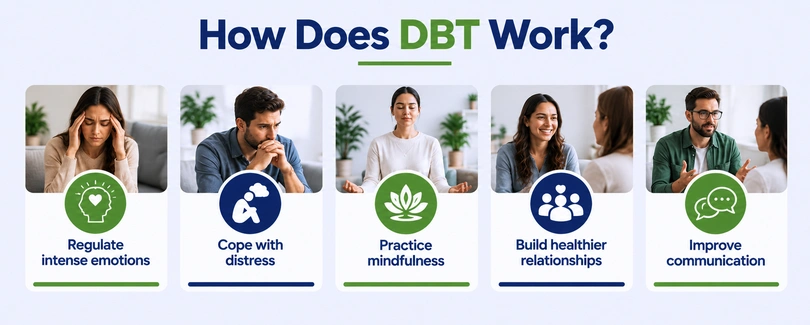
- Regulate intense emotions
- Cope with distress
- Practice mindfulness
- Build healthier relationships
- Improve communication
- Accept difficult experiences
- Reduce harmful or impulsive behaviors
DBT skills training covers four core modules:
-
Mindfulness
Mindfulness is the foundational module within DBT. It helps individuals notice and understand their emotions without immediately reacting to them.
-
Distress Tolerance
Distress tolerance teaches individuals how to cope with painful or difficult situations without making them worse through impulsive or harmful behavior.
-
Emotion Regulation
Emotion regulation skills help people understand, manage, and respond to intense emotions more effectively.
-
Interpersonal Effectiveness
Interpersonal effectiveness teaches people how to communicate clearly, maintain relationships, and manage conflict.
How Long Does CBT vs DBT Treatment Take?
When comparing CBT Vs DBT therapy, treatment structure is another important consideration.
CBT is often relatively structured and time-limited. A typical course of treatment for a single condition may last approximately three to six months, although the exact length depends on factors such as:
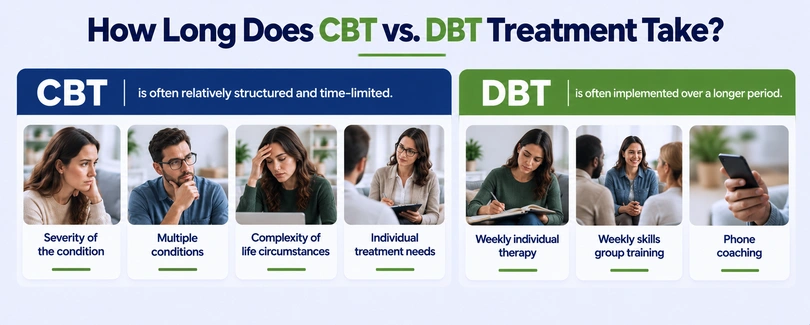
- Severity of the condition
- Multiple conditions
- Complexity of life circumstances
- Individual treatment needs
DBT is often implemented over a longer period. Adherent DBT usually lasts six to twelve months and includes four core components:
- Weekly individual therapy
- Weekly skills group training
- Phone coaching
- A therapist consultation team
Phone coaching provides real-time guidance on applying skills when problems arise between therapy sessions.
Many therapists also provide DBT-informed care. This involves individual therapy that incorporates DBT skills without including every component of a full adherent DBT program.
CBT Vs DBT for ADHD
When considering CBT Vs DBT for ADHD, the choice may depend on the difficulties a person experiences. ADHD treatment commonly includes medication along with therapy.
DBT has been applied to concerns involving emotional and behavioral difficulties and focuses on mindfulness, emotional regulation, distress tolerance, and interpersonal effectiveness.
CBT focuses on identifying patterns of thinking and behavior and developing practical problem-solving and coping skills.
For individuals with ADHD who experience difficulties with procrastination, problem-solving, or behavioral patterns, CBT skills may be useful. For individuals who experience intense emotions, anger, impulsive reactions, or difficulties managing distress, DBT skills may provide additional support.
The choice depends on symptoms, individual needs, and treatment goals.
CBT Vs DBT for Bipolar
The discussion around CBT Vs DBT for bipolar also depends on the individual’s symptoms and treatment needs. For bipolar disorder, medication is usually the primary/first-line treatment, with therapy.
CBT is used to address thoughts, behaviors, coping patterns, and specific symptoms. It can assist people in developing more balanced perspectives, improving problem-solving skills, and using structured coping strategies.
DBT emphasizes mainly emotional regulation, mindfulness, distress tolerance, and interpersonal effectiveness.
Someone facing difficulty in managing their thought patterns and behavioral difficulties may benefit from CBT strategies. Someone who also goes through intense emotions, impulsive reactions, or complications in managing distress may benefit from DBT skills.
A mental health professional can help by assessing symptoms, taking a treatment history, and setting individual goals when recommending the most appropriate approach.
CBT Vs DBT Vs ACT
Understanding the Differences
CBT is a comprehensive strategy focused on the relationship between thoughts, feelings, and behaviors. It often trains individuals to identify, examine, and alter unproductive patterns of thinking.
DBT is a specialized form of CBT that combines behavioral change with acceptance, mindfulness, emotion regulation, distress tolerance, and interpersonal effectiveness.
Acceptance and Commitment Therapy (ACT) is another approach within the broader group of cognitive and behavioral therapies. Similar to DBT, ACT incorporates acceptance-based techniques to help people respond to difficult thoughts and emotions in a healthier way.
The best therapy depends on a person’s symptoms, goals, preferences, and willingness to make changes.
When Should You Prefer CBT Vs DBT?
The most important factor in choosing between CBT and DBT is the type of issue you are experiencing.
CBT may be a better option for problems such as:
- Excessive worry
- Panic attacks
- Phobias
- PTSD
- Social anxiety
- Work anxiety
- Obsessive-compulsive disorder
- Insomnia
DBT may be a better fit for symptoms such as:
- Suicide-related thinking and behavior
- Unstable or intense relationships
- Anger problems
- Fears of abandonment
- Difficulty managing chronically intense emotions
- Impulsive or harmful emotional reactions
CBT tends to be more widely available. Others may relate more firmly to the acceptance and change approach of DBT. The therapeutic relationship is also important. People should feel satisfied with and able to trust their therapist.
Key Takeaways
- CBT focuses primarily on changing unhelpful thoughts and behaviors, while DBT combines change with acceptance and emotional regulation.
- CBT is more suitable for anxiety, panic, OCD, phobias, PTSD, BPD, and insomnia, while DBT can help with intense emotions, self-harm, distress, and relationship difficulties.
- Both therapies are structured, skills-based approaches that often include practice and homework between sessions.
- The best choice between CBT and DBT depends on individual symptoms, treatment goals, preferences, and professional recommendations.
How Inland Empire Behavioral Group Can Help You Heal
Overcoming difficult thoughts and overwhelming emotions starts with the right clinical approach. Speaking with a qualified mental health professional at Inland Empire Behavioral Group can help you better understand your needs and explore whether CBT, DBT, or another treatment approach may be right for you.
Our highly qualified team of mental health providers offers in-person and telepsychiatry appointments. We cover a wide range of insurance, so you don’t have to worry about the bills.
Start Your Personalized Treatment Plan Today!
Take Control of Emotional Distress and Behavioral Struggles
Managing anxiety, racing thoughts, or emotional burnout becomes much easier with the right clinical approach. Work with experienced mental health providers to identify whether CBT, DBT, or a specialized treatment plan is best suited to address your specific symptoms.
Schedule Your CBT or DBT Consultation Today