When a child struggles with anxiety, everyday situations like going to school, making friends, or sleeping alone can become overwhelming. Parents wonder whether their child’s fears are part of normal development or signs of an anxiety disorder. They may also have questions about therapy, medication management, and how to help their child feel safe without reinforcing their fears.
Key Takeaways
Childhood anxiety is treatable, and cognitive behavioral therapy (CBT) is one of the main evidence-based treatment options. Some children and teens also benefit from medication, depending on their symptoms, age, and individual needs. If your child is struggling with anxiety, Inland Empire Behavioral Group is here to help you explore personalized treatment options and find the right support for your child’s needs. Reach out to our team to discuss professional care for your child.
What Are The Common Signs Of Anxiety In Children?
Childhood anxiety involves ongoing fear or worry that feels bigger than the situation and starts to affect a child’s daily life. In a national survey, Merikangas et al. (2010) found that 31.9% of U.S. teens aged 13 to 18 had experienced an anxiety disorder at some point in their lives. The study also found that these symptoms often began around age 6.
Childhood Anxiety Symptoms Checklist by Anxiety Type
Five types cover most childhood cases:
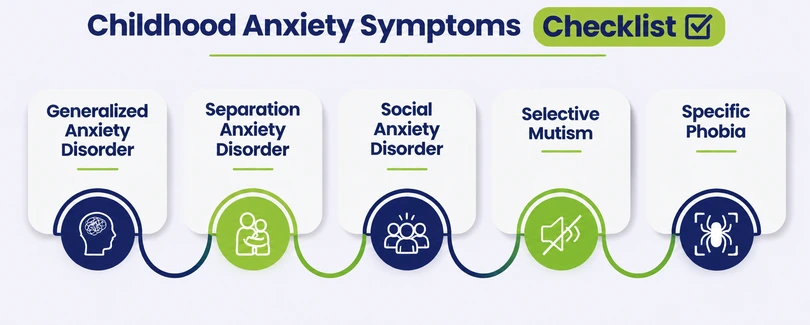
- Generalized anxiety disorder: excessive worry about many everyday topics
- Separation anxiety disorder: intense fear of being apart from parents
- Social anxiety disorder: fear of judgment in social settings
- Selective mutism: consistent silence in specific settings, such as school, despite speaking at home
- Specific phobia: intense fear of one object or situation, such as dogs or needles
Watch for the following signs for a few weeks; if they persist, consult a mental health psychiatrist:
- Complains of stomachaches or headaches before school or events
- Avoids school, parties, or new activities
- Asks for reassurance repeatedly
- Cries, clings, or melts down when facing a fear
- Sleeps poorly or fears sleeping alone
- Appears irritable, restless, or tense
Normal Childhood Fears vs. Anxiety That Needs Attention
Normal fears, such as fear of the dark at age 5, fade as children grow. Anxiety that needs attention meets three criteria:
- Duration: lasts most days for several weeks or longer. DSM-5-TR sets minimum durations of 1 to 6 months, depending on the diagnosis.
- Intensity: produces distress far larger than the situation needs
- Interference: disrupts school, friendships, sleep, or family routines
How Anxiety Shows Up in a Child’s Daily Life?
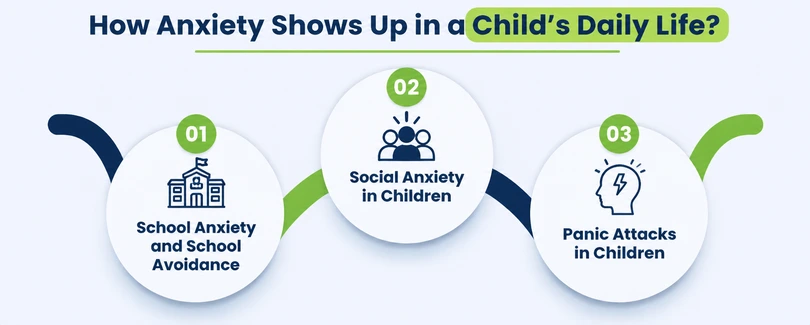
Anxiety shows up differently at school, with peers, and as a panic attack. School anxiety produces avoidance. Social anxiety produces isolation. Panic attacks produce intense physical symptoms that peak within minutes.
School Anxiety and School Avoidance
School anxiety centers on fears of tests, performance, teachers, or separation from parents. Typical signs include morning stomachaches, tears at drop-off, frequent nurse visits, and unfinished homework. Each avoided school day brings relief, and relief teaches the brain that avoidance works. That pattern strengthens anxiety and widens the gap with classmates.
Social Anxiety in Children
Social anxiety is intense fear of being judged, embarrassed, or rejected. Children with social anxiety avoid speaking in class, skip birthday parties, eat lunch alone, or refuse to order food themselves. Teens often hide the problem behind refusal to attend events. Friendships and classroom participation suffer as avoidance grows.
Panic Attacks in Children
A panic attack is a sudden surge of fear with a pounding heart, shortness of breath, dizziness, trembling, or a sense of doom. Symptoms peak within minutes. Panic attacks occur more often in teens than in young children. They do not accompany every type.
How Inland Empire Behavioral Group Treat Childhood Anxiety?
The most effective treatments for childhood anxiety are CBT, an SSRI medication, or both together. In the federally funded CAMS trial, Walkup et al. (2008) found that 59.7% of children improved with CBT, 54.9% with SSRIs, and 80.7% with both, compared with 23.7% on placebo. The trial enrolled children aged 7 to 17 with separation, generalized, or social anxiety disorder.
Cognitive Behavioral Therapy (CBT) for Children
CBT is a structured therapy. Children learn to spot anxious thoughts and use coping skills such as slow breathing and problem-solving. Sessions run weekly, and short practice tasks between sessions build the skills.
Your psychiatrist uses exposure therapy in which you both build a fear ladder: a ranked list of feared situations, from least scary to most scary. The child practices the lowest step until anxiety drops, then climbs to the next step. A child afraid of speaking in class might start by answering one question at home, then say one sentence to a trusted teacher, then raise a hand in class. Exposure feels hard at first, so a mental health provider paces each step. Each success shows the child that fear fades and that the child can cope.
How Parents Participate in Anxiety Therapy
Therapists also guide parents on how to support their kids during treatment. Parents learn three key skills to help their child manage anxiety:
- Reduce accommodation: Helping the child avoid situations simply to ease their anxiety.
- Praise brave behavior: Encourage small steps your child takes to face their fears, even when they feel uncomfortable.
- Practice therapy skills together: Help your child use the skills they learn in therapy in everyday situations.
Can Children and Teens Take Medication for Anxiety?
Yes. Children and teens can take medication when prescribed by an anxiety specialist after a full evaluation. SSRIs are the most common choice. Antidepressants carry an FDA boxed warning about suicidal thoughts in young people, so close monitoring is required.
Which Types of Medication Can Be Used?
Two antidepressant classes treat anxiety. SSRIs (selective serotonin reuptake inhibitors) are a first choice. SNRIs (serotonin-norepinephrine reuptake inhibitors) are a second option. A child psychiatrist prescribes and adjusts the medication, starting with a low dose. Early side effects include stomach upset, headaches, and changes in sleep.
How Can Parents Support a Child Who Struggles With Anxiety?
You can support a child with anxiety in the following ways:
- Listen to your child and acknowledge their feelings without judgment.
- Explain in simple language.
- Help your child face fears in small steps.
- Maintain consistent routines for sleep, meals, and daily activities.
- Praise your child for trying difficult things, even when they feel anxious.
- Work with teachers to address anxiety that affects school or friendships.
- Seek professional help when this condition interferes with your child’s daily life.
How to Explain Anxiety to a Child?
You must use simple words. Tell the child that anxiety is the body’s alarm system. The alarm sometimes rings when no danger exists. Name the body signs together: fast heartbeat, tight stomach, shaky hands. Explain that anxiety is common, treatable, and not the child’s fault. Give the feeling a name, such as “the worry alarm,” so the child can say “my alarm is loud” instead of melting down.
Can Natural Approaches Help With Childhood Anxiety?
Natural approaches work alongside professional care. They do not replace it. Common habits include the following:
- Aim for 9 to 12 hours of sleep for ages 6 to 12 and 8 to 10 hours for teens.
- 60 minutes of daily physical activity.
- Consistent mealtimes and bedtimes.
- Practice a 5-minute breathing or mindfulness exercise together.
When Should You Seek Help for Your Child’s Anxiety?
Consider professional help if your child’s anxiety persists, gets worse, or starts affecting school, friendships, sleep, or family life. A licensed mental health professional assesses your child’s symptoms and recommends a personalized treatment plan:
Look for these signs:
- Worry that continues over time
- Symptoms that become more intense or frequent
- Avoiding school or frequently missing classes
- Difficulty sleeping or maintaining friendships
- Stress that disrupts family routines or daily activities
A child psychiatrist evaluates your child through interviews with you and your child, and a review of symptoms and history. They can also consider other possible causes and check for co-occurring conditions, such as depression or ADHD.
If your child talks about suicide or self-harm, seek immediate professional help; call or text 988 for crisis support.
Support Your Child’s Mental Health With Professional Care at Inland Empire Behavioral Group
Watching your child struggle with anxiety can be difficult, but the right support can help them build confidence and manage their fears. Inland Empire Behavioral Group provides compassionate mental health care, including individual and family therapy, with in-person appointments in Riverside and Colton and telehealth options. Contact our team to discuss your child’s needs and explore treatment options that fit your family.
Our team welcomes new patients and accepts major insurance plans. So, help your child manage anxiety. Book your appointment today!
- Walkup, J. T., Albano, A. M., Piacentini, J., Birmaher, B., Compton, S. N., Sherrill, J. T., Ginsburg, G. S., Rynn, M. A., McCracken, J., Waslick, B., Iyengar, S., March, J. S., & Kendall, P. C. (2008). Cognitive behavioral therapy, sertraline, or a combination in childhood anxiety. New England Journal of Medicine, 359(26), 2753–2766. https://doi.org/10.1056/nejmoa0804633
- Merikangas, K. R., He, J.-P., Burstein, M., Swanson, S. A., Avenevoli, S., Cui, L., Benjet, C., Georgiades, K., & Swendsen, J. (2010). Lifetime prevalence of mental disorders in U.S. adolescents: Results from the national comorbidity survey replication--adolescent supplement (NCS-A). Journal of the American Academy of Child and Adolescent Psychiatry, 49(10), 980–989. https://doi.org/10.1016/j.jaac.2010.05.017