
What happens when a person who hurt you successfully persuades everyone that you are the one who hurt them? Instead of acknowledging your concerns, they may deny their fault and criticize you for bringing up the matter.
A scenario like this can leave you feeling confused, guilty, and unsure about what actually happened. This is what DARVO looks like!
Understanding DARVO is important, as it leads to emotional abuse, domestic violence, manipulation, and unhealthy relationship patterns. DARVO can make it difficult for people to speak up because their experiences may be denied and criticized.
“By denying, attacking, and reversing perpetrators into victims, reality gets even more confusing and unspeakable for the real victim.”
— Jennifer J. Freyd & Pamela Birrell,
DARVO is a manipulation tactic used by abusers in which they may attack the person confronting them and then reverse the roles of victim and offender. As a result, the original issue may become lost in the argument. Additionally, when this condition occurs repeatedly, it may contribute to confusion, self-doubt, and difficulty trusting one’s own experiences.
What Is DARVO Abuse?
The term DARVO abuse is often used to describe situations in which denial, attacks, and role reversal are repeatedly used as part of emotional manipulation or to avoid accountability.
DARVO itself describes a response pattern rather than a diagnosis or a separate type of abuse. However, when this pattern occurs repeatedly within an abusive relationship, it can become part of a broader pattern of emotional abuse and control. A person who suffers repeatedly from this condition may begin to feel confused after disagreements. They may enter a conversation believing they have a legitimate concern but leave feeling guilty, ashamed, or responsible for the entire conflict.
Over time, this emotional confusion can make it more difficult to recognize unhealthy relationship patterns.
The Origin of DARVO
The term DARVO was developed by psychologistJennifer J. Freyd to describe a pattern that can occur when people are confronted about wrongdoing. The concept has since been discussed in research and clinical conversations involving abuse, interpersonal manipulation, trauma, and accountability.
This condition can help explain why some people who experience harmful behavior may struggle to communicate their experiences or feel uncertain about speaking up. When a person’s concerns are repeatedly denied and turned against them, they may begin to question whether they are allowed to feel hurt or whether they are somehow responsible for the other person’s behavior.
What Does DARVO Stand For?
DARVO stands for Deny, Attack, and Reverse Victim and Offender. Each part of the pattern shifts the attention away from the original behavior and turns it toward the person who raised the concern.
D — Deny
DARVO is the first part of denial. When confronted about their behavior, a person may completely deny that anything happened or refuse to acknowledge the impact of their actions. They may say things such as “That never happened,” “I didn’t do that,” or “You’re making things up.”
Repeated denial can be particularly confusing, especially when someone insists that the other person’s memory or perception is wrong. Over time, this may cause the person experiencing the behavior to question their own understanding of what happened.
A — Attack
After denying the behavior, the person may attack the individual who confronted them. This can involve criticism, insults, blame, intimidation, or questioning the person’s character. Instead of discussing the original concern, the conversation may suddenly focus on statements such as “You’re too sensitive,” “You’re always causing problems,” or “You are the real issue here.”
RVO — Reverse Victim and Offender
The final part involves reversing the roles of victim and offender. The person accused of harmful behavior may begin presenting themselves as the victim while portraying the person who raised the concern as abusive, controlling, aggressive, or unreasonable.
This reversal can be particularly confusing because the person who originally experienced harm may end up apologizing or defending themselves instead of having their concerns addressed.
Prevalence of DARVO
Research suggests that this condition can occur when individuals are confronted with harmful behavior. Although there is no universal prevalence rate for the general population. In one study, nearly 72%reported that they confronted people who were using the DARVO pattern.
Darvo is also reported in cases of sexual violence. Of the around 89 college women who experienced campus sexual assault, approximately half reported experiencing DARVO-related tactics during conversations.
These studies suggest that DARVO can occur in different forms of interpersonal harm. However, research is still developing, and these findings should not be interpreted as a universal prevalence rate.
What are the Signs of DARVO?
One of the most disorienting aspects of this condition is the uncertainty it creates. A person may find themselves wondering if they really did something wrong. This confusion is not a sign of weakness; it’s a predictable response to a manipulation tactic that makes one question one’s own perception. You may notice patterns such as:
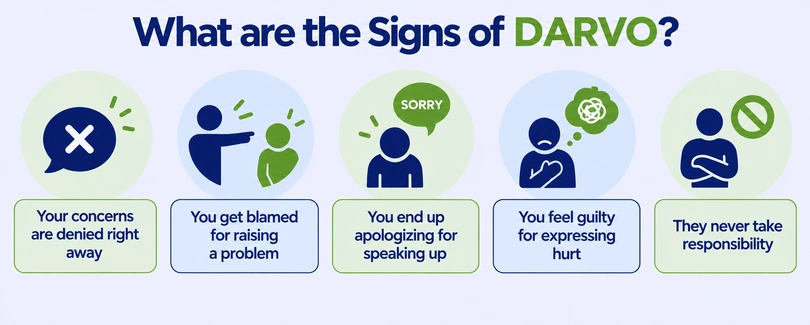
- Your concerns are immediately denied.
- A person in this condition attacks the other person for bringing up a problem.
- The conversation suddenly becomes about the other person’s feelings.
- You end up apologizing for raising a concern.
- A person may feel confused after confrontations.
- You may begin questioning your own memory or judgment.
- You feel guilty for expressing hurt.
- The other person avoids taking responsibility.
Note: one sign alone does not prove that DARVO is occurring. It is more useful to look for repeated patterns over time.
DARVO Examples
Examples in Relationships
-
Example 1: Emotional Betrayal
A person confronts their partner about lying. The partner denies the behavior, attacks them for asking questions, and then claims that the person is controlling and has caused them emotional pain.
-
Example 2: Verbal Abuse
An individual confronts their partner about repeated insults. The partner says the insults never happened, accuses the person of being overly sensitive, and then claims they are the real victim because their partner is “always criticizing” them.
Examples in Families
A family member confronts someone about hurtful behavior. The person denies what happened, accuses the opponent’s family member of creating drama, and claims that everyone is unfairly attacking them.
Examples in the Workplace
An employee reports inappropriate behavior. The accused person denies the allegation, questions the employee’s credibility, and portrays themselves as the victim of false accusations.
How does DARVO manifest in Emotional & Domestic Violence?
Darvo can occur in different ways; here is how it leads to emotional and domestic abuse:
DARVO and Emotional Abuse
Emotional abuse involves repeated behaviors that may manipulate, control, intimidate, humiliate, criticize, or undermine another person. Unlike physical abuse, emotional abuse may not leave visible injuries, but its effects can still be serious. However, Darvo can become part of an emotionally abusive pattern when it is repeatedly used to dismiss someone’s experiences and shift responsibility onto them. An individual in this state may begin to feel that expressing pain is unsafe because attempts to communicate are repeatedly met with denial, criticism, or blame.
Over time, emotional abuse may affect a person’s confidence, sense of self, ability to trust their own judgment, and willingness to speak openly about their experiences.
Darvo and Domestic Violence
Domestic violence is a pattern of abusive or controlling behavior that occurs within intimate or family relationships. It can involve physical violence, but domestic violence is not limited to physical harm. In these dynamics, abusers use DARVO to escape accountability by saying that they were provoked by the other person, which may confuse outsiders and isolate the other person. Domestic violence may also include emotional or psychological abuse, sexual abuse, financial abuse, threats, intimidation, and controlling behavior.
However, this can make it more difficult for victims to seek help because they may fear that they will not be believed. It can also create confusion when outsiders see only a person’s emotional reaction without understanding the larger context of the relationship.
The Connection Between DARVO and Narcissistic Traits
Narcissist Definition
The word “narcissist” is often used casually to describe someone who appears self-centered, manipulative, or excessively focused on themselves. However, narcissistic traits and a clinical mental health diagnosis are not the same thing. Some people may display traits such as entitlement, a strong need for admiration, difficulty accepting criticism, or limited empathy without having a personality disorder. For this reason, it is important to focus on specific behaviors rather than automatically labeling someone as a narcissist.
DARVO Narcissist Behavior
DARVO is sometimes discussed in relation to narcissistic traits because a person who has difficulty accepting criticism or taking responsibility may respond by denying wrongdoing, attacking the person who confronts them, and shifting blame.
However, DARVO does not automatically mean that someone is a narcissist. Likewise, observing narcissistic traits does not mean that someone has narcissistic personality disorder. Only a qualified mental health professional can diagnose narcissistic personality disorder.
DARVO Vs. Gaslighting
DARVO and gaslighting can both be confusing, but they are not the same. Gaslighting generally involves manipulating a person into questioning their memory, perception, or understanding of events. DARVO specifically refers to a pattern involving denial, attack, and reversal of victim and offender.
These behaviors can sometimes overlap. For example, someone may deny that an event occurred and insist that the other person is imagining things. They may then attack the person’s credibility and claim that they are actually being unfairly victimized.
What Is Darvo Reactive Abuse?
Reactive abuse is often used to describe a situation in which someone reacts emotionally or aggressively after experiencing ongoing provocation, manipulation, intimidation, or mistreatment. However, the term can sometimes be misleading because it may overlook the context of the situation and suggest that both people are equally responsible for an abusive pattern. It is important to consider the full circumstances rather than focusing only on one person’s reaction.
However, in some situations, a person may focus entirely on the victim’s emotional reaction while ignoring what happened beforehand. For example, someone may repeatedly insult or provoke their partner until the partner eventually yells. The person may then respond, “See, you’re abusive,” while ignoring their own repeated behavior.
This can resemble the Reverse Victim and Offender stage of DARVO.
Why Does DARVO Work?
DARVO works because it creates emotional confusion. When someone quickly denies the attacks that are raising concerns, it ultimately makes the original issue difficult to discuss. The person who experienced harm may become focused on defending themselves rather than addressing what happened.
Additionally, this condition can also contribute to guilt and self-doubt. An individual may begin wondering whether they were wrong to speak up or whether they somehow hurt the other person by expressing their feelings.
When this pattern occurs repeatedly, it may weaken confidence and make future conversations or confrontations more difficult.
What are the Effects of DARVO on Mental Health?
Darvo affects different areas of life, including mental well-being. This condition may lead to anxiety, depression, self-blame, and other consequences.
Some of them are discussed below:
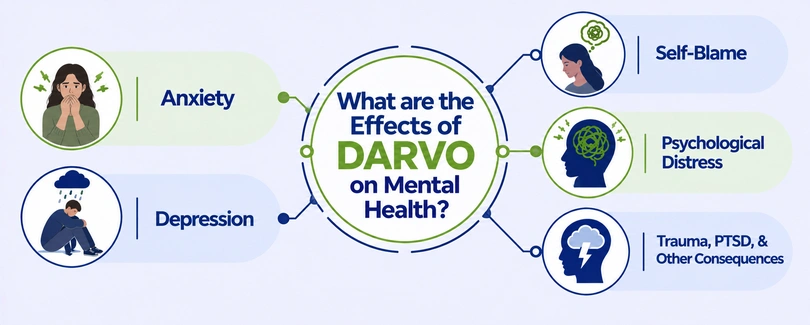
1. Anxiety
Repeated exposure to manipulation or emotionally unsafe interactions may contribute to anxiety-related symptoms such as constant worrying, hypervigilance, fear of conflict, second-guessing, and feeling as though you are “walking on eggshells.”
Ongoing stress can affect emotional well-being and may make it difficult for a person to feel safe or relaxed within the relationship.
2. Depression
Ongoing emotional manipulation and abuse may contribute to persistent sadness, hopelessness, low self-esteem, emotional exhaustion, feelings of powerlessness, and loss of interest in activities.
However, experiencing these symptoms does not automatically mean that someone has major depressive disorder. A mental health professional can assess symptoms and provide an appropriate diagnosis when needed.
3. Self-Blame
Research has linked exposure to DARVO with increased self-blame. When a person’s concerns are repeatedly denied or turned against them, they may begin to believe that they caused the conflict or somehow deserved the treatment they experienced.
Recognizing that harmful behavior is not automatically the victim’s responsibility can be an important part of rebuilding self-trust.
4. Psychological Distress
Repeated exposure to DARVO may contribute to emotional exhaustion, confusion, shame, fear, isolation, difficulty trusting others, and difficulty trusting oneself.
The impact can vary from person to person and may depend on the severity, duration, and context of the harmful behavior.
5. Trauma, PTSD, & Other Consequences
Excessive exposure to severe or repeated abuse can contribute to trauma-related symptoms in some people. These may include hypervigilance, intrusive memories, avoidance, emotional distress, difficulty feeling safe, and heightened reactions to reminders of the experience.
Professional support can be helpful when trauma-related symptoms interfere with daily life, relationships, sleep, or emotional well-being.
How to Recognize DARVO?
One of the most important ways to recognize DARVO is to remember the original issue. Ask yourself what you initially wanted to discuss and whether that concern was actually addressed. If the conversation suddenly shifts toward defending yourself against unrelated accusations, the focus may have been redirected. It can also help to look for patterns rather than judging a relationship based on one disagreement. However, healthy relationships can involve conflict, misunderstandings, and emotional reactions. The concern becomes more significant when denial, personal attacks, blame-shifting, and role reversal happen repeatedly.
How to Respond to DARVO?
Try to remain focused on the original issue rather than reacting to every accusation. You may choose to say that you are willing to discuss the issue but do not want to continue a conversation involving insults or personal attacks. Setting boundaries can be really helpful. For example, you may decide to pause a conversation if it becomes emotionally unsafe or unproductive. The other way to respond is by speaking with a trusted friend, counselor, or mental health expert who also helps the person process confusing thoughts and identify patterns more clearly.
If you are experiencing threats, violence, intimidation, or controlling behavior, prioritize your safety and seek support immediately
When to Seek Professional Support?
Professional support may be helpful when repeated interactions leave the person constantly questioning themselves or emotionally drained. Professional treatments like therapies and medications can provide a supportive environment to explore relationship patterns, process difficult experiences, rebuild self-trust, and develop healthier boundaries.
Seeking support can be important, especially when emotional manipulation occurs that leads to threats, controlling behavior, isolation, or domestic violence.
How to Treat DARVO?
Darvo can be managed effectively through professional treatment options. As the mental health professionals help by addressing the emotional and psychological effects of abuse, trauma, anxiety, depression, or other difficulties that may develop in response to harmful experiences.
A mental health professional can assess a person’s unique needs and recommend an appropriate treatment approach. The treatments include:
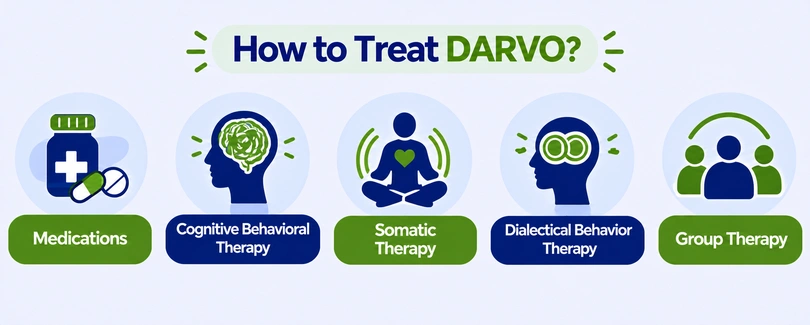
Medications
Medication may be considered when a person develops symptoms of conditions such as depression or anxiety. At Inland Empire Behavioral Group, a qualified healthcare professional determines the condition of the patient and then decides whether medication management is appropriate after considering the person’s symptoms, medical history, current medications, and other relevant factors.
Note: Medication can only be prescribed and monitored by a qualified healthcare professional and is often considered alongside psychotherapy.
Psychotherapy
Psychotherapy, or talk therapy, can provide a supportive space for people to process difficult experiences, understand unhealthy relationship patterns, rebuild self-trust, and develop coping strategies.
1. Cognitive Behavioral Therapy
Cognitive behavioral therapy (CBT) focuses on the relationship between thoughts, emotions, and behaviors. It can help people identify unhelpful thought patterns and develop healthier ways of responding to distress.
For someone recovering from emotionally harmful experiences, CBT may help address self-blame, anxiety, fear, isolation, negative thinking, and difficulties related to trauma.
2. Somatic Therapy
Somatic approaches focus on the connection between psychological experiences and physical sensations. Some trauma-informed approaches help individuals notice bodily responses associated with stress and difficult memories.
A qualified mental health professional can guide these techniques safely. Somatic approaches may be used alongside other forms of therapy depending on the person’s needs.
3. Dialectical Behavior Therapy
It is a form of cognitive behavioral therapy that focuses on emotional regulation, distress tolerance, mindfulness, and interpersonal effectiveness.
For people experiencing significant emotional distress, DBT can provide practical skills for managing intense emotions, improving relationships, and responding to difficult situations in healthier ways.
4. Group Therapy
Group therapy provides a structured and supportive environment where people can connect with others who may have experienced similar difficulties. It can reduce feelings of isolation and provide opportunities to learn from others while developing healthier coping strategies.
For people recovering from emotional abuse, trauma, relationship difficulties, or other stressful experiences, group therapy may provide an additional source of support when it is appropriately facilitated by a qualified professional.
Begin Your Journey Towards Healing At Inland Empire Behavioral Group
Are you constantly questioning your experiences after difficult conversations? Understanding DARVO and other patterns of emotional manipulation can be the first step toward rebuilding trust in yourself.
At Inland Empire Behavioral Group, we have an expert team of mental health professionals who offer compassionate treatments by combining multidisciplinary approaches. Our experts provide a safe and supportive space so you can talk about your issues without fear of judgment. We cover a wide range of insurance plans so you don’t have to worry about bills and reimbursements. You can also get virtual treatments through telepsychiatry appointments.
Book your consultations today!
Is DARVO Affecting Your Mental Health? We Can Help
You have the right to share your feelings without fear of blame, attack, or guilt for speaking up. If DARVO is affecting your mental health and daily life, get help at Inland Empire Behavioral Group.