Eye movement desensitization and reprocessing (EMDR) is a form of psychotherapy that helps people process distressing memories. During treatment, a therapist guides you to focus on a specific memory while engaging in bilateral stimulation, such as eye movements, alternating taps, or tones.
Distressing memories can continue to affect you long after an event has ended. Inland Empire Behavioral Group offers EMDR therapy to help you process these memories, manage emotional distress, and build a stronger sense of control over your daily life.
Key Takeaways
If distressing memories are affecting your daily life, schedule a psychiatric appointment with us today to discuss your symptoms, explore whether EMDR therapy is appropriate for your needs, and take the first step toward professional mental health care.
What is EMDR Therapy?
EMDR is a structured, eight-phase therapy that helps to process emotionally painful experiences with the support of a licensed mental health psychiatrist. The individual focuses on the specific memory while engaging in bilateral stimulation that includes eye movements. The therapy only helps to deal with the memory instead of erasing it.
Psychologist Francine Shapiro developed EMDR in 1989. The approach rests on the adaptive information processing model. This model suggests that distressing experiences can be stored in an unprocessed form and keep producing symptoms. Shapiro (2014) describes this model and its use for symptoms linked to adverse life experiences. The model is a framework for treatment. It is not just an explanation of how EMDR works.
What Are the Eight Phases of EMDR Therapy?
EMDR has the following eight phases in which both a mental health provider and an individual seeking therapy work together.
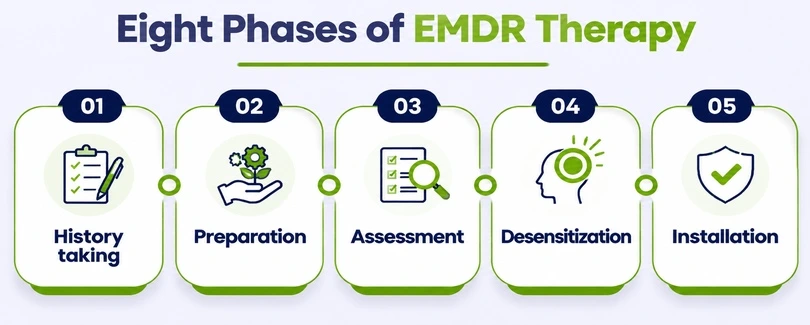
- History taking: Your provider gathers history and sets treatment goals.
- Preparation: Teaches you coping and stabilization skills.
- Assessment: You have to identify the target memory, a negative belief, and a preferred positive belief.
- Desensitization: You process the memory during sets of bilateral stimulation.
- Installation: Your positive belief strengthens.
- Body scan: Here you check for leftover physical tension tied to the memory.
- Closure: Your provider stabilizes you at the end of each session.
- Reevaluation: The provider reviews your progress at the next session.
Phases one and two happen early. Phases three to eight repeat across later sessions for each target memory.
What Happens in the Brain During EMDR Therapy?
Landin-Romero et al. (2018) reviewed the proposed mechanisms in a systematic review. The working-memory model suggests that a dual-attention task competes with the memory for limited mental resources. This makes the memory less vivid and less distressing. Physiological models point to changes in arousal and to links with processes in rapid eye movement (REM) sleep. Neurobiological models point to changes in brain activity during processing.
The mechanism debate also covers the eye movements themselves. Studies that compare EMDR with and without eye movements report mixed results. An earlier meta-analysis found no added benefit, while Lee and Cuijpers (2013) found a moderate benefit in treatment studies (d = 0.41). This debate does not remove EMDR from the list of effective treatments. It shows that researchers still disagree on which component does the work.
What Happens During an EMDR Therapy Session?
An EMDR session lasts 60 to 90 minutes. A mental health provider guides you through short sets of bilateral stimulation and checks in after each set. Early sessions focus on history and preparation.
The first sessions cover trauma history, current symptoms, goals, and readiness for memory processing. The therapist teaches calming and stabilization skills before any processing begins.
What Does an EMDR Session Feel Like?
Responses vary. Some individuals notice emotions, body sensations, new images, or shifts in how a memory feels. Your provider guides the pace, and you do not need to force any response.
How Many EMDR Sessions Do You Need?
Treatment length depends on the number and complexity of target memories. A single memory can take three to six sessions. Long-term trauma often takes eight to twelve sessions or more. No provider can promise a fixed number or rapid results.
What Happens After a Session?
Your provider ends each session with closure. A calming exercise that returns you to a steady state before you leave. Processing continues for hours or days afterward. You may notice vivid dreams, new memories, emotional waves, or tiredness.
Between sessions, write down new thoughts, dreams, and body sensations, and use the calming skills from the preparation phase. At the next visit, your provider reviews your notes and rates how distressing the target memory feels now.
What Is EMDR Therapy Used For?
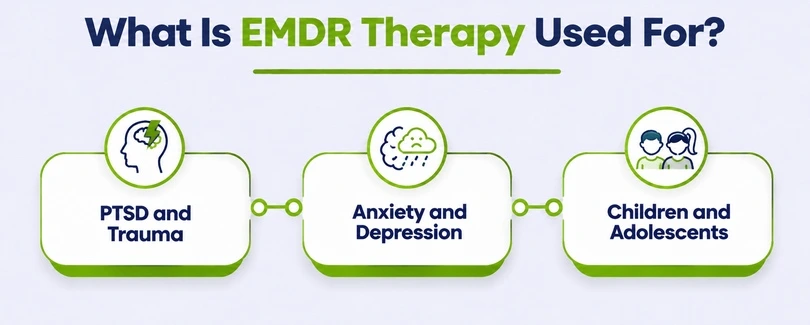
EMDR therapy is primarily used to treat post-traumatic stress disorder (PTSD) and trauma-related symptoms. Research supports its effectiveness for PTSD, including in children and adolescents, for whom the World Health Organization recommends EMDR as a treatment option (WHO). EMDR has also been studied for anxiety and depression.
However, the strength of evidence varies across conditions. (Valiente-Gómez et al., 2017; Moreno-Alcázar et al., 2017)
At Inland Empire Behavioral Group, we provide EMDR therapy for the following mental health conditions:
PTSD and Trauma
Our psychiatric team treats PTSD with EMDR. We use it for symptoms that follow a single traumatic event and for signs that follow long-term trauma. Our team evaluates your symptoms and creates a personalized treatment plan according to each patient’s history and goals.
Anxiety and Depression
We use EMDR for anxiety and depression that stem from distressing memories. Common examples include phobias, anxiety that occurs alongside PTSD, and depression that improves as trauma symptoms improve. Our psychiatrist team assesses each diagnosis first and then creates a treatment plan that fits your unique needs.
Children and Adolescents
We provide EMDR therapy for children and adolescents experiencing trauma related symptoms. Our team adapts each session to the child’s age, comfort level, and individual needs. This creates a supportive environment that helps them process difficult experiences at their own pace.
What Are the Benefits and Limitations of EMDR Therapy?
Benefits include:
- Helps to reduce PTSD symptoms
- Follows a structured approach
- Does not require detailed verbal recounting
Limitations include:
- Emotional ups and downs
- Temporary emotional discomfort
- Not a stand-alone cure at all.
Is EMDR Therapy Safe?
Yes, EMDR is generally safe when a professional mental health provider delivers it. The most common effects are temporary: emotional intensity, fatigue, vivid dreams, or difficult memories between sessions.
Your provider assesses dissociation, emotional stability, and support systems before memory processing begins. Also, do not use any self-guided tools. Anyone with thoughts of self-harm should contact 988, the crisis line or emergency services right away.
Explore EMDR Therapy With Professional Guidance
You do not need to diagnose yourself or decide which treatment is right for you before seeking care. At Inland Empire Behavioral Group, our team understands your symptoms, treatment goals, and previous experiences with mental health care. We help you explore appropriate options, including EMDR therapy, and determine whether in-person or online sessions best fit your needs. We are in-network with major health insurance plans. We are accepting new patients.
Ready to take the next step? Contact us to schedule an assessment and discuss whether EMDR therapy is right for you.