
Imagine walking into a group session with people you do not know can be overwhelming. However, every person in the group setting is there for a similar reason, but the initial awkwardness may cause you to feel anxious.
Key Takeaways
That’s where icebreakers in group therapy come in. Icebreakers allow people to overcome the initial awkwardness within the group by doing small activities. Mental health professionals consider icebreakers really important in group therapy sessions. As they allow people in the group to develop good relationships, reduce tension, and create a warm, comfortable environment that helps them heal.
Understanding these activities is the first step towards making group therapy way more rewarding.
What is Group Therapy?
Group therapy is a form of psychotherapy that helps people feel less isolated and provides a sense of connection. It is a safe, stable, and caring environment where a small group of people come together and share their experiences. As a result of group therapy, structure is provided within a person’s life, and they can learn and recover. It is an evidence-based treatment that has proven beneficial for individuals.
What are Icebreakers?
Icebreakers are activities designed to help individuals get to know each other and foster communication in group therapy sessions. The main aim of icebreakers is to create a healthy, relaxed, comfortable, and productive atmosphere where each participant feels free to share their thoughts and emotions without hesitation, fear of criticism, or judgment.
Icebreakers for group therapy are fun or engaging activities that increase the participation of individuals in group settings. With the help of icebreakers, each group member gets a chance to learn the essential things to get relief from mental illness.
Why Does Every Session Need an Ideal Icebreaker for Group Therapy?
The main purpose of group therapy is to rely on connection. As per the Renowned psychiatrist Irvin Yalom, there are two key factors in healing within a group, which are universality and group cohesion. Universality gives people a sense of relief that others have experienced similar difficulties to them, and cohesion gives people a feeling of support and belonging within the group.
An ideal icebreaker for a group therapy activity accelerates this bonding process by:
- Reducing emotional defenses
- Normalizing being anxious
- Providing support
- Transitioning into the session
How to Develop the Icebreaker Strategy?
Ice-breakers should be chosen carefully to support therapeutic goals, group dynamics, and group development.
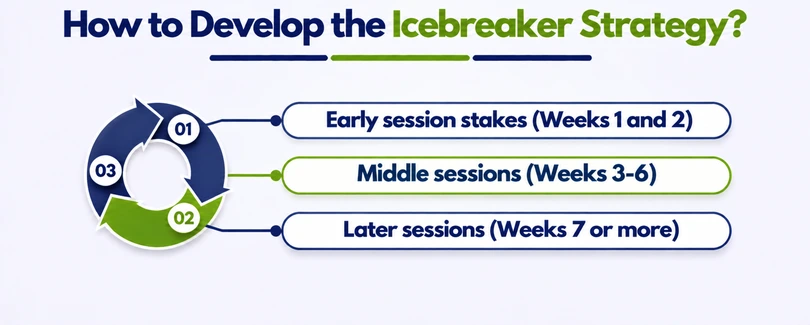
Pacing Across Multiple Sessions
- Early session stakes (Weeks 1 and 2): In the early sessions, ice-breakers should be light-hearted and non-invasive. For example, exploring people’s favorite comfort foods or morning routines. This encourages people to speak in front of others.
- Middle sessions (Weeks 3-6): In these sessions, the ice-breakers should encourage people to reflect on their coping strategies, personal boundaries and self-awareness.
- Later sessions (Weeks 7 or more): Ice-breakers should foster positive feedback between group members. They should allow people to reflect on things they are grateful for and progress.
What are Trauma-Informed Icebreakers for Group Therapy?
People who have been through trauma may find it triggering to be asked personal questions or to make eye contact. So, good, trauma-informed group ice-breakers will create a safe environment and provide stability. Here are some of the key principles that should be followed in a group setting
- Allowing people to opt out: All participants should know they can choose to skip the question or provide a short answer with no explanation.
- Use of metaphors: Using metaphors allows people to express how they are feeling without having to directly describe any traumatic experiences.
Effective Trauma-Informed Prompts
- Weather Check-In: Instead of asking people how they are feeling, mental health professionals ask them to describe how they are feeling as a weather forecast. For example, “Partly cloudy with a chance of afternoon rain.” This allows people to express their emotions in a safe way.
- Grounding Item: Asking the group participants to have a look around the room (or their bag) and find an object that represents a sense of calm, strength, or comfort for them at this moment in time.
What are Age-Specific Icebreakers for Group Therapy?
The mental health professional chooses the icebreakers as per the age groups. Some activities may be confusing for younger children or adolescents. Here are some of the icebreakers for different age groups.
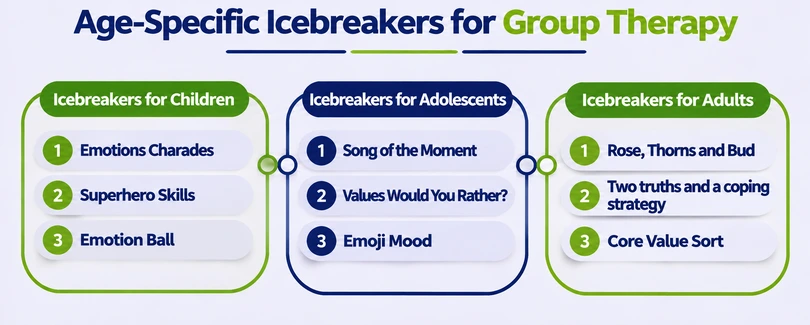
Icebreakers Activities for Children
Activities for children should involve movement, playing, and imagination.
- Emotions Charades: Children act out an emotion (excited, frustrated, shy, proud). The group can guess the emotion. This helps children learn new emotions.
- Superhero Skills: In this activity, the children are asked to draw or think of a superpower that they have. For example: a good listener, a fast runner, or a funny friend.
- Emotion Ball: Mental health professionals ask the kids to write a range of emotions on a soft ball. When the child catches the ball, they should talk about a time they felt that particular emotion, based on where their thumb landed.
Icebreakers for Adolescents
Here are some of the activities that resonate well with teens as they allow creativity and feel natural and relaxed:
- Song of the Moment: asking teens to share a song that matches how they’re feeling, or a lyric that means something to them?
- Values Would You Rather?: Making fun activities with teens by saying ” Would You Rather” questions to start some light conversation. For example: “Would you rather have the ability to rewind it by 10 minutes?”
- Emoji Mood: Asking adolescents to select 2 emojis from their phones. One to represent how they have been feeling this week, and one to represent what they would like to get out of this session.
Icebreakers for Adults
Here are some of the activities that are great for helping adults relax and connect around common life experiences:
- Rose, Thorns and Bud: Share with others what you have been most grateful for this week (Rose), what has challenged you (Thorns), and what you are looking forward to (Bud).
- Two truths and a coping strategy: Similar to the classic ‘two truths and a lie’ in this game, members share two interesting facts about themselves and one healthy coping strategy they practice when stressed.
- Core Value Sort. Giving participants a number of cards with values on them (Honesty, Harmony, Creativity, Family, Independence). Asking them to pick one value that is most important to them at the moment and explain why.
What are the Fun Icebreakers for Group Therapy?
Playful activities help to reduce tension within the group and create a sense of connection. They allow people to relax and remind them that there can be positive feelings in difficult times as well.
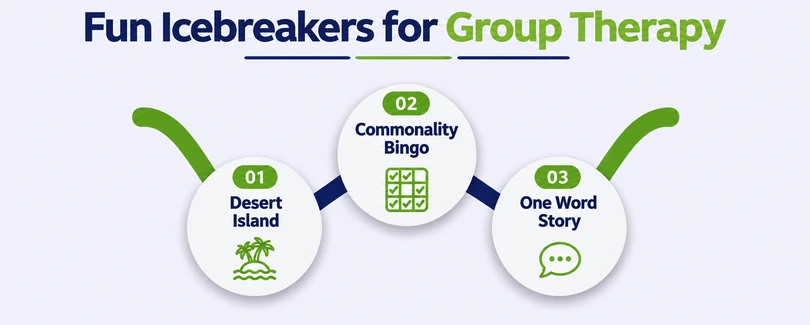
Here are some of the fun icebreaking activities
1. Desert Island
What 3 things would you take to a desert island? These could be a favorite snack, a comfortable blanket, or a favorite film.
2. Commonality Bingo
Give everyone a bingo card with questions that do not relate directly to anyone’s mental health problems (such as eg: “Has a pet,” “Prefers tea over coffee,” “Listens to podcasts,” “Has stayed up too late reading”). As people interact, they should find others who have commonalities with them in order to complete the bingo.
3. One Word Story
Going around the group, everyone adds one word to make a funny story. This encourages attention to what other people are saying, creates a good laugh, and removes pressure from individuals.
What Is the Most Powerful Icebreaker for Group Therapy?
In group therapy, the powerful game to play is any activity that makes a group member feel affirmed in their humanity, without forcing them to be immediately vulnerable in a painful way.
When people feel seen and accepted for who they are, barriers can be broken down. An excellent activity to encourage this is “the strength mirror”. Most of the people are not familiar with this term. Here is how the strength mirror runs.
- Set the Intention: Once a few sessions of group therapy have been held and a general relationship has been built in the group, group members are asked to sit in a circle.
- Resilience: Making the group members briefly reflect on a small challenge they had to overcome to make it to this session.
- Peer Validation: After a member of the group has shared their experience, ask 1 or 2 peers to share their personal strengths. For example, determination, bravery, or insight.
- Close with gratitude: Thank the group members for attending this session. This activity allows people to turn everyday challenges into visible evidence of their resilience.
Start Your Group Therapy Journey With Inland Empire Behavioral Group
A supportive environment and positive connections can create a stronger sense of resiliency and help with healthy coping strategies. If you feel like you or any of your loved ones are struggling with anxiety, depression, trauma, or any major life challenges, know that you do not have to navigate this alone.
The Inland Empire Behavioral Group will walk beside you in this journey. We have a certified team of mental health professionals who create structured group therapy options that suit your needs in the best way. We cover a wide range of insurance as well, so you don’t have to worry about the bills and reimbursements. Our dedicated team of experts provides a safe and comfortable environment where you can talk your heart out without the fear of judgment.
Contact our team today to learn more!
- Kilanowski, J. F. (2012). Breaking the Ice: A Pre-Intervention Strategy to Engage Research Participants. Journal of Pediatric Health Care, 26(3), 209–212. https://doi.org/10.1016/j.pedhc.2012.01.001
- Group therapy is as effective as individual therapy and more efficient. Here’s how to do it successfully. (2023, March 1). https://www.apa.org. https://www.apa.org/monitor/2023/03/continuing-education-group-therapy
- Chugani, C. D., Goldstein, T. R., Salk, R. H., Poling, K., Sakolsky, D., & Brent, D. (2020). Group intervention for young adults with mood and anxiety disorders transitioning to college. Journal of Psychiatric Practice, 26(2), 120–125. https://doi.org/10.1097/pra.0000000000000456