
Numbers are a part of our lives. From telling time to managing money and making investments, they play a significant role. And let’s be honest, these numbers sometimes feel complex to all of us. But what if even a small mathematical equation or performing arithmetic operations to solve a simple mathematical logic problem feels overwhelming? Or does it take too much time to figure out final calculations, or have you always had trouble with math in school or currently at your job? It’s not a sign of weak intelligence; it can be a symptom of Dyscalculia.
Dyscalculia is a specific learning disability. It’s defined as an impairment in arithmetic fluency. It diminishes a person’s ability to remember mathematical logic, perform operations, recall the base-10 system, and can make them feel stuck on basic math questions.
Today’s blog post defines dyscalculia and will cover every aspect of it, including symptoms, causes, treatment, and more.
Key Point
- Dyscalculia is a math learning disorder.
- It is associated with brain regions responsible for numerical processing (areas around the Intraparietal Sulcus and the Frontal Lobe.
- It makes people struggle to process numbers and quantities and feel overwhelmed by mathematical concepts.
- It is an inborn condition that can’t be cured but is highly manageable with the right care and support.
What Does the Word Dyscalculia Actually Mean?
Dyscalculia is a medical term. It is a word combining two ancient languages: Greek and Latin. The prefix dys– comes from Greek, which means bad or difficult. Similarly, calculia in Latin means calculare; combining both becomes “difficult calculating”.
What is Meant By Math Disability or Math LD?
Dyscalculia or Math LD is a learning disability. In simple terms, it represents a person’s deficiency in mathematical skills compared to their peers. People with such conditions find it harder to solve simple equations, evaluate quantities, and calculate numbers. It’s a lifelong condition, impacting specific areas of life significantly, earlier in academic performance, and later in employment.
Do People with Dyscalculia Have a Lower IQ?
No, being stuck in math doesn’t mean they have low IQ levels. It just highlights their brain inefficiency in executive function or performing maths with as much precision as others without dyscalculia. Also, people in similar conditions do not always mean they are not good in other subjects. In fact, affected people perform well in other subjects with good grades.
They have an average IQ, like many of us, but have impairment in some brain regions that handle all the counting and numeric calculations.
What are the Best Examples of Mathematical Disability?
Below are some examples of number blindness at every stage of life.
A Child in School
A child with a mathematics learning disorder may struggle to understand basic numbers even after performing the same task multiple times. For example, when a simple equation 2+1 =? is given, instead of writing the answer quickly, as the same question has been solved multiple times already in practice, the child counts each number individually, either on fingers or by drawing lines on paper.
An Adult in Daily Life
With such a condition, the person’s intuitive math skills can be impacted. They may feel overwhelmed when multiplying the cost of a good, dividing restaurant bills among friends, or rely on finger counting to check money in their pocket after every small purchase.
How Common Is Dyscalculia?
It can be considered common. Although 25% of the world population has math learning difficulties, according to the British Dyslexia Association, which means they are not very good at numbers, it doesn’t mean they have dyscalculia. Several studies from verified sources found that approximately 3% to 7% of the global population, including children and adults, can struggle with such conditions.
Popular & Influential Study On Dyscalculia
Here’s what the very famous and influential study by Mazzocco and Myers states.
To determine the prevalence of dyscalculia in children, several studies were conducted. But the study by Mazzocco and Myers is very popular. This study was conducted over several years on 209 primary school children. Researchers used two diagnostic criteria for dyscalculia diagnosis: one was the Poor Achievement Model, and the second was the IQ-Achievement Discrepancy Model. In this research, out of 209 children over the course of several years, only 22 children were diagnosed as having persistent maths difficulties.
Important Factors Highlighted in this Study:
In this study, they conclude that diagnosing math difficulty in children is complex. Because diagnosing one child with one testing method meets the criteria, but the same child appears normal in the second one. Also, students who were diagnosed with a math learning disability in one year didn’t meet the criteria later. So, they state that diagnosis of dyscalculia in children is complex. Accurate diagnosis requires comprehensive evaluation at different stages; a single, one-time assessment can’t be reliable.
How Does the Brain Process Numbers in People With Dyscalculia?
Before understanding how it affects the brain, it is necessary to understand how our brain actually works.
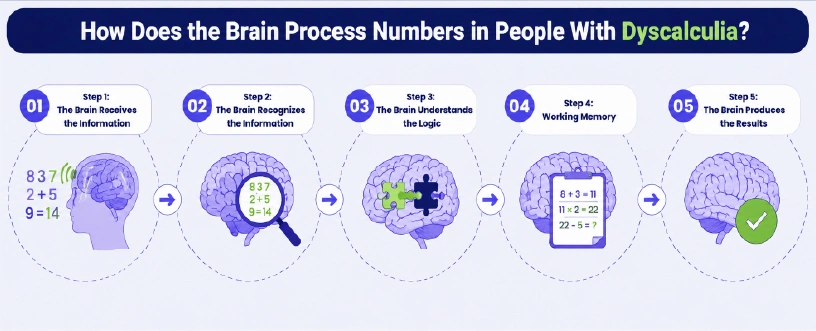
Behind every calculation, even solving a small equation like 3+2=?, our brain processes the information through several steps. During this entire process, several brain regions are involved, working together to help find precise final numbers. These areas mainly include the Intraparietal Sulcus (IPS) for neurometric processing, the Prefrontal Cortex for attention, the Angular Gyrus for recalling basic math facts, and the Hippocampus for memory and storage.
Processing the information, the neurotypical person’s brain finds the result 3+2=5. As people affected by dyscalculia have brain structure differences compared to people without dyscalculia, their brains have different ways to learn, process, and perform mathematical algorithms. This term is referred to as neurodivergent.
Here’s how the brain processes numbers in neurotypical people and those affected by math dyslexia.
Let’s consider “3+2=?” the equation to solve
Step 1: The Brain Receives the Information
When you see the equation or logic, the eyes send information to the brain for processing, and it’s the foundational step behind every calculation performed by everyone.
Step 2: The Brain Recognizes the Information
This is the next step, where the brain recognizes what the information is. The brain identifies that 3 and 2 are numbers and (+) is the arithmetic operator.
People with Dyscalculia: For affected people, acknowledging the numbers as quantities is often difficult or takes too long to comprehend.
Step 3: The Brain Understands the Logic
At this point, the brain translates the equation into what it actually means and in which order they have to be done. For example, adding amounts or quantities.
People with Dyscalculia: This step is performed in the region of the intraparietal sulcus. In people with dyscalculia, this area is weaker or often underactive. So, that’s why they can’t process numerical magnitude with as much precision as it is in normal people. With this, understanding quantities and their relation is much harder for affected people.
Step 4: Working Memory
When your brain fully understands the numbers and symbols and has created instructions on what to do. Then, it uses working memory. It is a cognitive skill that helps you to store information for a short time. Meanwhile, allowing you to use or manipulate it as per the instructions to solve a specific problem and find answers or results.
People with Dyscalculia: People who have an inborn learning disability have lower working memory capacity, especially visuospatial working memory. For them, storing information temporarily and running the manipulation process simultaneously is not easy, which leads to less efficient results.
Step 5: The Brain Produces the Results
When the brain performs and processes all the calculations, the results are produced: 3+2=5.
People with Dyscalculia: Their brain takes too much time to process and present the results.
That’s how the brain works behind every equation in both normal and affected people. To understand how dyscalculia affects the brain, let’s identify the symptoms that can be noticed under such a condition, indicating whether the brain is working properly or faces trouble recognizing and processing numerical data.
Before identifying symptoms, it’s crucial to understand that people experiencing this disability do not always have a deficiency in every mathematical step. They either have only one area of difficulty in math or have less efficiency in several mathematical skills. These include:
| Verbal | Unable to name numbers, quantities, and mathematical terms properly |
| Graphical | Inability to write numbers and numeric operators or special symbols on paper |
| Lexical | Difficulty in reading math signs or symbols |
| Operational | Less efficient in performing basic maths operations, such as addition, subtraction, multiplication, or division or struggles using right operations during problem solving |
| Practagonistic | Difficulty in recognizing quantities |
| Ideognostic | Complications in understanding math algorithms and logics |
The terms listed above are not the officially diagnosed subtypes of dyscalculia; rather, they are descriptive classifications. Each defines an individual’s specific skill deficiency or challenges in arithmetic.
What are the Symptoms of Dyscalculia?
Some authentic sources agree that the first signcould be decreased ability to subitize. It is the ability to quantify things, such as objects, without actual counting. As the child grows, the ability to subitize develops, rising to 5 to 7 objects by adulthood. However, the symptoms of Specific Learning Disorder in Mathematics can vary, depending on several factors, including age, developmental stage, task complexity, and other factors. It’s commonly seen that the symptoms in children change as they become older, turning number processing difficulties into significant everyday challenges.
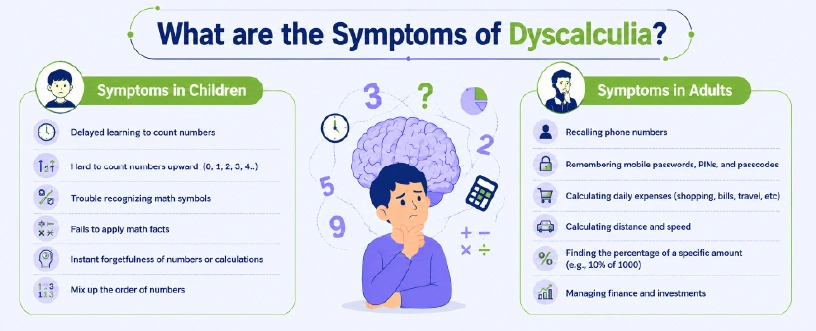
Below are some signs that might be noticed across every age group.
Symptoms in Children
The number difficulty symptoms in children could be:
- Difficulty matching words with their numerical letters
- Delayed learning to count numbers
- Hard to count numbers upward (0, 1, 2, 3, 4..)
- Trouble recognizing math symbols
- Fails to apply math facts
- Instant forgetfulness of numbers or calculations
- Mix up the order of numbers
- Struggles in counting money or cost calculation
- Find it complex to read an analog clock
- Counting basic numbers on fingers
- Repeatedly counting small quantities
- Counting backward
Symptoms in Adults
Adult dyscalculia symptoms could be one or more of the following, depending on the age and the encountered tasks:
They struggle in:
- Recalling phone numbers
- Remembering mobile passwords, PINs, and passcodes
- Calculating daily expenses (shopping, bills, travel, etc)
- Calculating distance and speed
- Finding the percentage of a specific amount (e.g., 10% of 1000)
- Managing finance and investments
Alongside these, people also experience some emotional symptoms as a natural response. These include anxiety, fear, frustration, and anger, which can also result in passive-aggressive behaviours.
What Causes Dyscalculia?
As discussed, it is a neurodevelopmental condition. That’s why it can be multifactorial and, of course, complex. Researchers have not found the exact reason yet, and they believe there is no single cause behind. Several studies say that dyscalculia can be a combination of various factors, such as genetic variations, differences in brain structure, cognitive deficits, and other factors.
Here are some of the causes of number blindness development:
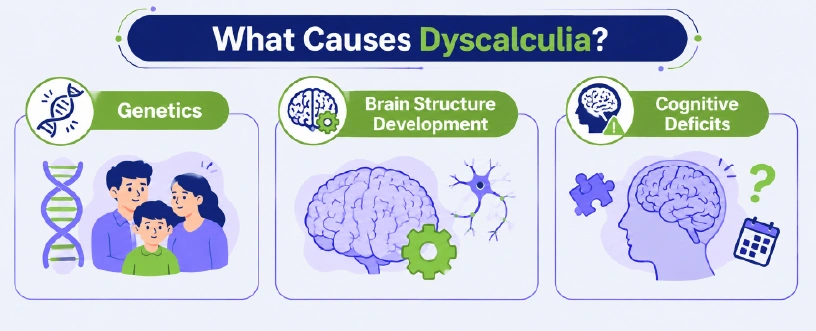
Genetics
Dyscalculia is typically inborn. Means, you can be born with it. The risk becomes much higher if the patient or a sibling is already experiencing a similar condition.
Brain Structure Development
Through various neuroimaging studies, like Magnetic Resonance Imaging (MRI), a specialized technique that scans the human brain, show that people with dyscalculia have significant differences in brain structure. Researchers have shown that some areas that are utilized the most by the brain during numerical calculation, number processing, and memory have reduced gray and white matter. Such number-related areas are often the intraparietal sulcus and the Frontal Lobe.
Cognitive Deficits
Specific cognitive skill impairment, such as memory and visuospatial processing, can also be a cause of developing dyscalculia. Difficulty recognizing numbers and trouble learning arithmetic or mathematical symptoms can make it hard to understand and solve numbers.
These are some of the major causes found through studies that have been conducted so far. Still, the exact cause remains hidden. Also, the reason behind their differences or impairment doesn’t have an established, universally agreed-upon study.
What are the Different Types of Dyscalculia?
Math dyslexia has three main types: developmental, acquired, and pseudo. Each presents individuals’ experiences of development, which lies behind how and when, not how it impacts. In all of the three types, developmental dyscalculia is most common, while the other two types are considered rare. Here’s what each defines:
- Developmental: It means the patient is born with number blindness. And according to researchers, most of the people have inborn maths learning disability.
- Acquired: People who experience difficulty with number processing and calculation due to unpleasant events, like brain injury or trauma, are classified as having acquired dyscalculia. It’s not something you are born and raised with, but developed later. This type of math disability is unusual; only a few people after a head injury lose memory and previously learned math skills.
- Pseudo: This type represents that inadequate maths functioning is not innate or a result of an accident, but developed gradually due to extreme maths anxieties and stress.
How Does Figure Blindness Affect Daily Life?
From banking sectors to daily life budgeting, everything revolves around numbers, even the clock. Experiencing difficulty in number calculation impacts someone’s life significantly. Children with such conditions struggle in academic performance, while adults encounter challenges at work. In a nutshell, life is affected badly in every domain.
Here’s how the disability impacts life:
School Performance
Children remain less attentive in math-related subjects or panic when the teacher writes equations on the board. They make repeated mistakes even after practicing multiple times or being instructed clearly, affecting overall academic success.
Employment
Completing daily tasks on time and ensuring great performance are some primary job elements. Dyscalculia affects people, especially those in sectors like banking, STEM, construction, and more, who fail to maintain projects and meet basic job requirements, increasing the risk of losing a job.
What Jobs Can I Do If I Have Dyscalculia?
People who experience numerical dyslexia can choose counseling, photography, or caregiving as a career to maintain work-life balance.
Everyday Life (Shopping, Cooking & More)
Dyscalculia makes everyday life harder. People often find it hard to calculate their life expenses and feel disorganized in budgeting. They find it difficult to process price tags or calculate discounts while shopping. Similarly, in cooking, they misestimate the quantities of sauces or spices in food.
Does Dyscalculia Affect Driving?
Yes! While driving, people may exceed speed limits or can’t maintain a necessary distance due to deficient number understanding and calculation.
What Conditions Commonly Occur With Numerical Dyslexia?
As dyscalculia and dyslexia belong to the neurodivergent family, the likelihood of co-occurrence is much higher. In fact, according to Mazzocco and Myers’ study (discussed earlier), approximately 25% of children who were diagnosed with persistent math disability also had a reading disability. Recent studies also show that dyscalculia causes co-occurrence of other disabilities. According to the Dyscalculia Network, in affected people, 20-60% are those who also meet the criteria for other learning disability types, like dyslexia and dysgraphia.
Despite that, it can also cause several mental health disorders. When someone deals with calculation challenges, they are often frustrated and feel too anxious, leading to conditions like anxiety disorders, depression, etc.
Here are some of the co-occurring conditions:
Attention-Deficit Hyperactivity Disorder (ADHD)
In clinical settings, it is identified that people with learning difficulties also have symptoms of ADHD. Although both conditions are different, but indirectly linked because, in both conditions, people have low working memory, making it hard to attentively perform multi-step calculations under Attention Deficit Disorder and decreased number-manipulating skills in dyscalculia.
If you are noticing ADHD signs alongside number blindness, it’s necessary to consult a doctor for arithmetical disorder and ADHD testing.
Anxiety Disorder
It’s very common for children during exams to forget arithmetic logic and steps, even after long practice, making them anxious. Similarly, a continuous decline in jobs productively, making people consistently think about “what if” scenarios. This recurring pattern of thoughts increases the risk of developing extreme, crippling anxiety.
Depression
Similar to anxiety, it can make children and adults highly depressed. Due to significant difficulty calculating numbers, people often experience low self-esteem or self-criticism, a sign of self-abandonment. Also, significant impairment in daily life makes them feel hopeless.
Bipolar Disorder
There’s no evidence that dyscalculia can directly cause bipolar disorder; however, they can co-occur. According to a study, a continuous lack of mathematical performance is observed in most of the adolescents diagnosed with bipolar disorder.
Dyscalculia vs Dyslexia: What’s the Difference?
Many people consider dyscalculia and dyslexia the same, which they are not. Although both are specific learning disabilities, the areas impacted by each are different.
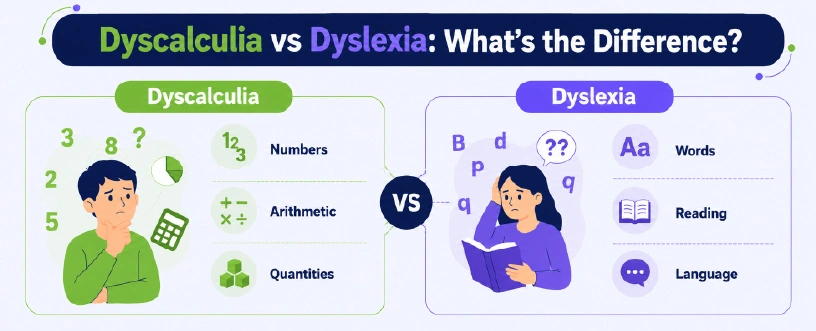
People with dyscalculia struggle with numbers, while dyslexia is defined as difficulty in reading.
| Dyscalculia | Dyslexia |
| Numbers | Words |
| Arithmetic | Reading |
| Quantities | Language |
Being different, they often coexist. Several studies identify that a significant proportion of people with low math abilities also face difficulties with written language and words.
Can You Have Dyscalculia Without Dyslexia?
Yes, it is absolutely possible. Belonging to the same family, different brain regions are impacted by both the Intraparietal Sulcus in dyscalculia and the Left Hemisphere in dyslexia. That’s why it is highly possible to be diagnosed with a math disability even if you don’t have dyslexia, or vice versa.
How Is Dyscalculia Diagnosed?
To be diagnosed with this disability, it’s necessary to meet the official diagnostic criteria in the DMS-5-TR. Not everyone with poor math efficiency is meant to be affected, as maths is complex for some.
However, the condition can be diagnosed by certified psychiatrists and neuropsychologists.They evaluate the individual’s conditions as per the criteria to determine whether number complexities are actually a specific learning disorder.
Diagnostic Criteria for Arithmetical Disorder
An individual is diagnosed with a math-related learning disorder if:
- The individual’s history of at least the past 6 months meets any one of the following measures:
Difficulty recognizing numbers, foundational number facts, or basic math concepts
Difficulty applying math logic and mathematical reasoning
- The mathematical performance is below what can be considered average or low compared to others at the same age.
- The difficulty in math must begin in school, despite it intensifying later in life.
Experiencing symptoms, adults recognize the need for diagnosis. However, for children and adolescents, it’s difficult to understand their mental condition. For them, teachers’ and parents’ support matters, as they can be the ones who notice the signs first, helping in early diagnosis to prevent significant interference later in life.
Can Tests Help Diagnose Dyscalculia?
No, there’s no test for numerical dyslexia. Mental health professionals evaluate people as per the DSM-5-TR diagnostic criteria. However, for a comprehensive, in-depth analysis, some tests, such as tests for inhibition and memory, may be suggested by the professional.
Can Dyscalculia Be Cured?
When diagnosed with such conditions, the first question that comes to mind is: Can it be cured? It’s important to know that dyscalculia is a lifelong condition; it can’t be cured, but it can be effectively managed with specialized tutoring and training.
Same for children: there’s no cure, but mathematical skills can be developed with targeted intervention, such as educational support and dedicated math tutoring. The reason is that from birth to the mid-20s, the brain is in the development process, and early support makes the condition highly treatable.
How Is Dyscalculia Treated?
It can be treated through educational therapies, tutoring, school accommodations, and several other approaches. Children can learn great mathematical skills with academic support and dedicated tutoring. Such approaches ensure they understand, recognize, and calculate numbers precisely gradually.
Fun-driven mathematical questions or practical examples help improve their number learning capabilities. Allowing children to take extra time during exams makes them less anxious, while the supportive environment encourages them and boosts focus. As children’s brains are in a developmental process, they can easily adapt mathematical skills and gradually become good at math.
Here’s a quick look at how parents and teachers can help children with dyscalculia:
| Parents | Teachers |
| Real-life math practice | Classroom accommodations |
| Positive reinforcement | Multisensory teaching |
| Reducing math anxiety | Extra time |
How to Overcome Mathematics Learning Disorder as an Adult?
For adults, learning sessions can be beneficial, but they may not be as beneficial as they are for children. So, they can use technology and request accommodations.
How Can the Inland Empire Behavioral Group Help?
We help people living with dyscalculia by offering mental support and emotional healing. With a lack of arithmetic skills, people often feel hesitant, judge themselves, and experience emptiness. Our specialized psychotherapy helps them process negative beliefs and ensures emotional support.
Also, repeated failure or being unable to solve a problem can cause anxiety and depression, and as discussed earlier, this learning disability can often co-occur. Our certified psychiatrists are dedicated to delivering whole-person care to every individual through a combined treatment approach, including:
Psychotherapy
Psychotherapy is a specialized treatment approach. Through this, we offer individuals a quiet, collaborative space to share math-anxious thoughts and emotions to be understood. Our licensed mental healthcare practitioners work closely with affected patients and help them recognize feelings and learn coping strategies to overcome distress. In this process, we use evidence-based treatment types, personalized to individuals’ needs. These include:
- Cognitive Behavioral Therapy (CBT)
- Acceptance and Commitment Therapy (ACT)
Medication Management
In mental health, medication plays a crucial role. Through our psychiatric medication managementservices, we help patients get relief from anxiety and depression. This offers them relief, ensuring they manage arithmetic problem-solving questions without panicking and handling numbers in everyday life effectively. At Inland Empire Behavioral Group, medication is prescribed by certified psychiatrists after a detailed evaluation.
Call Us For Support!
Inland Empire Behavioral Group helps patients at every step to ensure mental wellness through personalized, compassionate care. If you want any mental support, feel free to contact us at (909) 429-3244; we are here to help!