
All of us experience manipulative tactics that may affect our psychological behavior. We may feel emotionally drained and fearful, which may indicate that we are dealing with Emotional Manipulation. It is a condition in which people gain control over others by avoiding taking responsibility for their actions. It’s a very delicate way of using dissatisfaction to make someone feel guilty. Most of us don’t even know that we are going through it. These behaviors are usually intentional or unintentional, as some people learn them from family, society, or the media. It happens because we are unaware of how to communicate and control emotions in healthier ways.
Emotional manipulation slowly deteriorates an individual’s confidence, which may lead to low self-esteem that can be very harmful. It usually happens in relationships, the workplace, or with friends who truly care about you. Figuring out symptoms and understanding the condition is important, as it enables us to manage it earlier.
This blog will provide a clear understanding of what emotional manipulation looks like, its signs, how it affects you, and tactics to recognize it earlier, as this condition can severely affect our day-to-day lives if it remains untreated.
What Emotional Manipulation Looks Like?
Emotional manipulation is a behavioral dynamic in which someone tries to control how you handle your emotions or act by using underhanded or indirect ways that make you doubt yourself. With time, emotional manipulation makes such changes in a person that they start to doubt themselves, lose confidence, and feel emotionally exhausted.
It is a behavior in which a person controls another person’s emotions to influence their decisions or the way they think about a situation. Realizing this condition can be an important step toward building healthy and balanced relationships. When a person identifies that they are suffering from such manipulative behaviors, they can empower themselves to set boundaries, protect their emotional health, and foster more connections. Emotional manipulation is a pattern of behavior where one person influences another person to achieve a desired outcome. It can occur intentionally or without the person recognizing that they are dealing with emotional manipulation. People use these tactics to gain control, get what they want, or avoid conflict. However, over time, it can cause harmful effects like trust damage, feelings of distress, fear, and shame.
Moreover, understanding emotional manipulation is the first step in rescuing yourself. When you get to know what the root causes of such behavior and its warning signs are, you can respond with greater assurance, communicate more effectively, and build healthier relationships.
What are the Forms of Emotional Manipulation?
Emotional manipulation can occur in different ways. But in reality, its nature depends on how it controls, changes behavior, and manipulates individuals. It usually occurs in a relationship where two people affect each other.
Emotional manipulation doesn’t always reveal negative emotions; it can occur as love-bombing. A manipulator tries to make the other person feel safe and loved before they confuse them with a new act of cruelty.
There are some of the forms of emotional manipulation that we may face in everyday life, which are following:
- Judgments based on likes and dislikes
- Criticism and blame shifting
- Invalidation, mocking, and disappearance of feelings
- Ignoring your feelings, necessities, and fascinations
- Humiliating and accusing others of their own misbehaviors
Scenario
Manipulation can occur in several forms; it can also use blame or guilt to gain authority and possession. They may say things like, “If you really loved me, you’d be here for me,” or “I do so much for you, but you can never care for me.”
These sentences indicate that the manipulator is trying to make the other feel culpable; they try to make them guilty by repeating their words again and again until you agree with their concerns. It’s the type of manipulation where they use your feelings to influence your options. However, as time passes, it eventually creates feelings of guilt and pressure and makes you lack confidence in yourself.
Recognizing such behaviors can help in managing them efficiently. We should set healthy limitations to protect our emotional well-being and improve our relationships.
Signs of Emotional Manipulation
There are some common signs that represent its occurrence. These signs show that emotional manipulation can help you recognize when someone may be making an effort to control your thinking, emotions, or behavior.
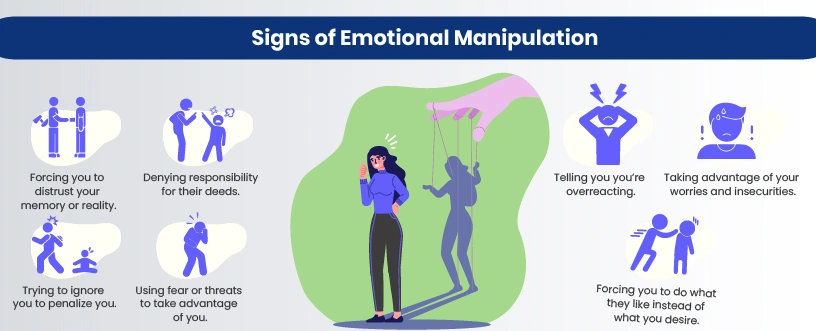
- They try to make you feel regretful to get their way.
- Forcing you to distrust your memory or reality.
- They make you feel bad by showing that they are always pulling you
- Denying responsibility for their deeds.
- Trying to ignore you to penalize you.
- Using fear or threats to take advantage of you.
- Repeatedly putting you down or making you feel degraded.
- Telling you you’re overreacting.
- Taking advantage of your worries and insecurities.
- Forcing you to do what they like instead of what you desire.
How Does the Cycle of Abuse Work?
Emotional abuse occurs in a loop that makes it extremely difficult to leave. This cycle generally involves four stages, which include:
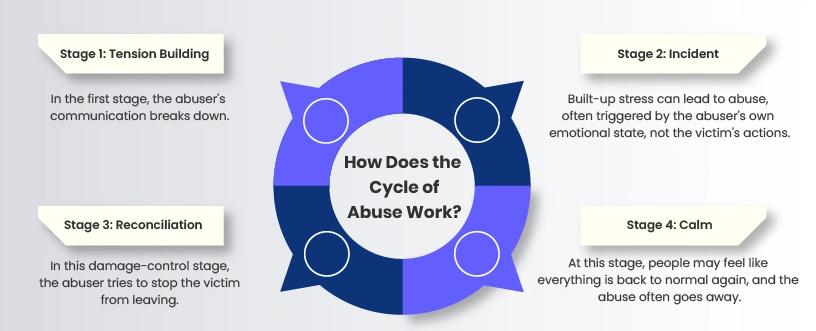
Stage 1: Tension Building
In the first stage, the abuser’s communication breaks down. The person experiencing abuse feels like a “walking on eggshells” to avoid upsetting the abuser.
Abuser behavior: Extreme irritability, mood swings, and minor emotional outbursts. They often use the silent treatment to hurt the other person.
Victim response: The person who is going through abuse becomes hyper-vigilant, trying to remain silent to prevent an outburst.
Stage 2: Incident
The excessive built-up stress breaks into an act of abuse. However, it can be triggered by the abuser’s internal emotional state instead of the victim’s actions.
Abuser tactics: Someone in this stage makes verbal attacks, gaslighting, or exhibits extreme controlling behaviors.
Victim reaction: The person who is experiencing all this feels shocked, confused, and frightened.
Stage 3: Reconciliation
At this stage, the abuser enters “damage control” mode. It is the stage where the victim might leave, so they convince them by doing certain behaviors.
Abuser behavior: They suddenly change their behavior and show passionate affection, apologies, and make promises that they will change. They use love-bombing tactics just to please them or minimize the incident.
Victim response: The victim may feel like they might be changed, feel relief, and have a sense of hope.
Stage 4: Calm
At this stage, people may feel like everything is back to normal again, and the abuse often goes away.
Behavior of the abuser: The behavior changes after apologizing, justifying their actions, or even pointing out that the victim provoked them.
The Result: In this period, a relief is provided by the abuser.
What are the Effects of Emotional Manipulation?
Prolonged exposure to manipulation activates the body’s stress systems and damages self-concept. People often live in a state of confusion between self-blame and fear. It impacts mental and emotional well-being, causes difficulties in managing relationships, and leads to low self-esteem.
Fragile Relationships
Emotional manipulation severely impacts your mental health and causes difficulties in managing relationships. It makes the relationships fragile and toxic, leading them to withdraw to reduce further manipulation. They are not able to trust any other person in the future, which further leads to isolation from everyone.
Emotional and Mental Health
Emotional manipulation leads to mental health issues, such as depression and anxiety. It also causes physical issues such as fatigue, headaches, feeling drained, and disturbances in sleep. Individuals constantly doubt their self-worth, which leads to difficulties in making decisions in life.
Struggle in Making Decisions
Individuals who have suffered through manipulation have extreme issues in making decisions, as the manipulator keeps them dependent. One may constantly self-doubt when making decisions, such as career choices, personal choices, or daily activities.
Other Factors
- Regular Anxiety & Hypervigilance
- Low Self-Esteem
- Depression & Emotional Numbness
Over time, these reactions may evolve into generalized anxiety disorder, complex trauma, or mood instability if untreated.
What are the Tactics of Emotional Manipulation?
Emotional manipulators use different tactics to control how another person feels, thinks, or behaves. These behaviors often create guilt, confusion, fear, or self-doubt, making it harder for the other person to set boundaries or make independent decisions. There are several aspects through which it can be recognized that a person is being emotionally manipulative.
These include:
1. Guilt-dripping
It’s a common tactic used by emotional manipulators to control thoughts and emotions. They make you question your own self-esteem by making you feel guilty for doing nothing. They may ask questions like this: Do I deserve this after all I have done for you? I guess my feelings don’t matter to you! If you really love me, buy me an expensive thing!
However, these questions make you unsure about your own worth and, over time, cause guilt. It’s really important to make yourself a priority and set boundaries to avoid manipulation.
2. Gaslighting
Gaslighting is a psychological and emotional abuse that makes you question your memory and sanity. It can happen in any relationship, such as the workplace, family, or friends. It’s the most dangerous tactic by the manipulator, which makes you think that you are holding false beliefs.
For example, if there is a shooting star in the sky that you have seen, you ask the other person, and they start accusing you by saying, ” What are you talking about? This question makes you think that you might see things that others can’t. It’s a very sneaky and wild form of manipulation.
3. The silent treatment
Manipulators use the silent treatment as a punishment; instead of talking and making things better, they start behaving coldly. They manipulate the emotions and make the other person think that they are worth nothing. They start behaving as if you were a stranger, and you become invisible to them. The manipulators use this silent treatment as a weapon to be more powerful and dominating. Over time, you become used to this cold behavior.
4. Playing as a victim
The manipulators blame the other person for all the misdoings to get sympathy from others. They portray themselves as a good person and never share the other side of the story. It eventually makes the other person guilty, and they start blaming themselves for every mistake.
For example, you don’t care about me! They accuse their partner of everything.
5. Exploiting Insecurities
The manipulator becomes your well-wisher to get to know all your weak points and insecurities. They exploit the insecurities to gain power and to have control in the relationship; it can be an experience, a fear, or an appearance. The manipulator uses their insecurities to make them feel underconfident.
For example, if they have a small height, they continue to remind them about it to chip away at their confidence. After some time, it makes them think that they have so many flaws, and they are lucky to have that manipulative partner.
6. Love bombing
It’s a tactic used in emotional manipulation relationships. A manipulator uses flattery and praises the partner excessively. At the start of the relationship, they show that they are obsessed with their partner by giving attention and gifts just to gain control. They make others feel like they are in love.
Here is an example of manipulation: they may say “I love you” so early and show the other person that they can’t live without them. However, when the manipulator knows that they have gained power over their partner, they show their narcissistic behavior and start devaluing them. They suddenly show their true self by being cruel, controlling, and criticizing.
7. Triangulation
A manipulator involves a third person to make their partner jealous or to cause conflict. They spend more time with others to make their partner insecure and talk badly about their partner to third parties. However, an example of a manipulator is: when two people are fighting, they often add the child into the conflict just to emotionally make the other person feel bad. To cope with triangulation manipulation, one should stay focused on the facts or have a direct conversation with the person to avoid manipulation.
8. Twisting facts
Manipulators use this technique to make the other person ashamed of themselves. They constantly provoke the other person to think the other way; they lie, exaggerate, and convince them in their own ways. This tactic makes the individuals confused over what is right and what is wrong, and they question their own self-worth. However, the manipulators weaken their ability to think the way they were thinking.
9. Emotional and physical blackmail
This tactic is very common in manipulation; the manipulators threaten and pressure their partner just for dominance and power. They get what they want by blackmailing them, such as threatening them that they will leave them or take away the children. They often resort to violence just to comply with their own demands.
10. Denial
This tactic is commonly used by the manipulators to avoid the situation by just refusing. They don’t acknowledge their wrong actions. This denial can be in many ways, such as pretending they forget what happened, protecting themselves by saying it was your fault, or by avoiding accountability. The denial works in two ways: by blaming or by avoiding the responsibility.
11. Public humiliation
The manipulator remains calm and supportive alone, while in public, they make their partner feel unworthy or dumb. The manipulator uses sentences like this, why are you wearing this short dress? You look so fat in this dress! This causes extreme stress, as it shakes the person’s personality and makes them feel hurt.
12. Playing dumb to take advantage
Individuals pretend like they don’t know anything and behave like they are dumb. However, deep down, they are very clever, and they know what is happening. They just pretend to be dumb just to avoid responsibility or gain an advantage. This tactic helps them to get to know the mental capability of the other person. Manipulators often hurt the feelings and emotions of others and claim that they didn’t even realize their behavior.
How does Intentional Manipulation differ from Unintentional Manipulation?
All tactics of emotional manipulation differ from each other in different ways. Some people learn behaviors in their childhood about how to manipulate others without realizing it. Whereas there is another category who use manipulation purposely to control or benefit from others.
Unintentional Manipulation (Learned Childhood Behaviors)
Most of the time, in childhood, we behave in a manner as a survival mechanism, which then leads to manipulative behaviors. For example, a child who learned that crying brought comfort may grow up using this coping mechanism to keep loved ones close. A child who avoided disputes by taking away may later use the silent treatment in relationships.
These behaviors are usually natural and often come from distress or harmful attachment patterns.
Intentional Emotional Manipulation
Intentional manipulation is another form of manipulation that happens when someone intentionally uses another person’s emotions to gain control for their advantage. It may appear as guilt, dangers, falsehoods, or emotional tension, even when they know it causes harm. Intentional manipulators mostly like to stay dependent on others and make it their comfort zone, show little genuine guilt, and may continue or increase the manipulation when met face to face.
So the main discrepancy is that a learned coping behavior is an involuntary reaction that develops to feel safe. On the other hand, intentional manipulation is an intentional choice to gain control.
When to Seek Professional Help?
If you feel like you are experiencing emotional manipulation that is affecting your day-to-day life. Then it’s the right time to get professional treatment. Mental health professionals emphasize trauma-informed care and emotional safety. And if manipulation leads to depression, anxiety, or self-doubt, get professional help immediately.
How to Cope with Emotional Manipulation?
It can be managed with the right combination of treatments. Only a mental healthcare professional can recognize the cycle of emotional manipulation and recommend treatments. Here are some of the common therapies that may help people to overcome this condition.
Cognitive Behavioral Therapy (CBT)
It’s an evidence-based therapy that has proven effective for helping people who have been manipulated. People experiencing this state have feelings of worthlessness, guilt, low self-esteem, and more. So basically, CBT helps in changing the symptoms, thoughts, feelings, and behaviors, which leads to making one’s condition worse. CBT targets unsettling thoughts and beliefs by intervening in thoughts and changing them into desired ones.
Dialectical Behavior Therapy (DBT)
It is also a form of Cognitive Behavioral therapy. DBT is helpful for those who are struggling with emotional manipulation or abuse. It is based on the idea that two opposing things can co-exist, so in a therapy setting, it means that you can accept your thoughts and emotions and still move on from them by changing them into productive thoughts and emotions.
Eye-Movement Desensitization and Reprocessing Therapy
This therapy is really helpful for those who have suffered abuse and manipulation, have low self-esteem, and have traumatic memories. Therefore, trauma therapy such as Eye-Movement Desensitization and Reprocessing Therapy can be a beneficial treatment for trauma. In this, a person moves their eyes in bilateral movement from left to right. This method stimulates the brain, helping it to desensitize the information about the traumatic event in the past.
Support Groups
Support groups play an important role in reducing the symptoms of trauma. As it provides a sense of connection with others. It provides a nurturing environment where you can talk about your issues, and people share their experiences with others who are struggling with the same issues.
Reclaim Your Mental Well-being at Inland Empire Behavioral Group
Breaking free from psychological manipulation begins with awareness, but true healing requires safe, professional support. If you’ve experienced gaslighting, guilt-tripping, or toxic relationship dynamics, know that these experiences can be repaired with the right therapeutic care. At Inland Empire Behavioral Group, our licensed clinicians specialize in helping individuals recognize manipulation patterns, rebuild self-worth, and develop healthy emotional boundaries. Through compassionate, evidence-based therapy, we guide you toward clarity, resilience, and long-term mental well-being.