
Imposter syndrome can make even meaningful achievements feel difficult to own. You may receive praise, earn a promotion, or reach an important goal and still wonder whether you truly deserve it. Instead of feeling confident about what you have accomplished, you may worry about living up to expectations or being “found out” as less capable than others believe.
Although these feelings can occur at different stages of life, psychologists Suzanne Imes and Pauline Rose Clance first described the phenomenon in 1978 after studying high-achieving women who struggled to recognize their own accomplishments.Clance & Imes (1978).
Imposter syndrome is not rare. Estimates of how many people experience it range widely, from roughly 9% to as high as 82% of the population depending on the population studied and how researchers measured it (Bravata et al., 2020). The feeling shows up in students, executives, new parents, and career changers alike. It responds well to therapy, and understanding the pattern is the first step toward changing it.
What Is Imposter Syndrome?
Imposter syndrome describes a persistent belief that your success is undeserved, along with a fear that other people will eventually discover you are not as capable as they think you are. It is also called imposter phenomenon and refers to a pattern of self-doubt that continues even when there is evidence of competence and achievement.
What are the common Imposter Syndrome thoughts?
Imposter syndrome can affect how you interpret your accomplishments and everyday challenges. Instead of feeling confident after doing well, you start to question whether you really earned the success or worry about meeting expectations the next time. The common thoughts include the following:
- I only got this job because they were short-staffed
- Someone will eventually realize I don’t belong here
- My success was luck, not skill
- If I ask for help, everyone will see I don’t know what I’m doing
- I have to work twice as hard to keep up the appearance of competence
For some people, these feelings become stronger after a major accomplishment. Greater responsibility can create new pressure to maintain the same level of success. This reinforces the fear that others will eventually discover they are not as capable as they believe themselves to be.
What Are the Signs of Imposter Syndrome?
Common signs of imposter syndrome include the following behaviors:
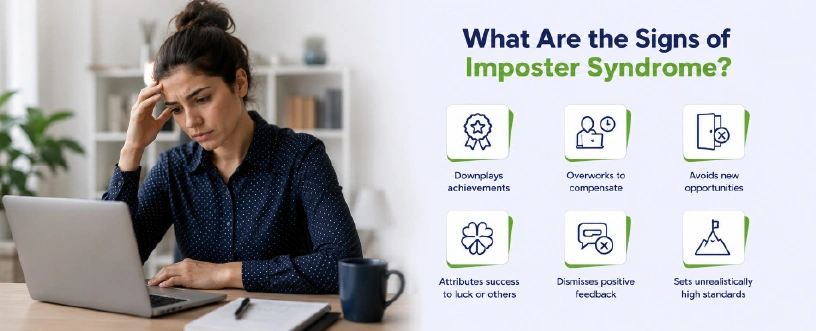
- Downplays achievements instead of accepting credit
- Overworks to compensate for perceived inadequacy
- Avoids new opportunities out of fear of failure
- Attributes success to luck, timing, or other people’s help
- Dismisses positive feedback as politeness rather than fact
- Sets standards so high that meeting them still feels insufficient
What Are The Causes Of Imposter Syndrome?
There is no single factor why someone develops imposter syndrome. The following are the potential factors that can cause this behavior
Childhood and family expectations
Excessive praise and insufficient recognition from parents are both linked to imposter behavior in adulthood. Kids who get praised for everything, even if they earned it or not, often grow up unsure if the compliments actually mean. Also, the kids who rarely get recognized for their efforts carry that into adulthood as a constant need to overachieve just to feel like they are finally enough.
Perfectionism and personality traits
Perfectionism can make imposter feelings stronger. When you set extremely high standards for yourself, even a good result feels like it is not good enough. Research has also linked imposter feelings with traits such as low self-efficacy and neuroticism. Bernard et al. (2002).
New roles and transitions
Imposter feelings can appear when you enter a new stage of life. They also begin when you take on more responsibility. Starting college, beginning your first job, receiving a promotion, changing careers, or becoming a parent can all bring new expectations and uncertainty about whether you are ready.
Social comparison and social media
Nowadays, it is easy to compare yourself with other people’s achievements. This happens particularly on social media. If you carefully see the highlights of someone else’s life, it can make your own challenges feel like a sign that you are falling behind or not doing enough.
Workplace or academic environment
Environments with high performance pressure, limited feedback, or a culture of silence around struggle make imposter feelings more prominent and less likely to be discussed openly.
Belonging and discrimination
Not all imposter feelings come from within. For students and professionals from underrepresented groups, real experiences of discrimination can feed into it too.Research found that among ethnic minority college students, imposter feelings made the effects of discrimination on mental health even worse. This means exclusion doesn’t just cause imposter feelings; it deepens them. So telling someone to just “change their mindset” can miss the real problem entirely. Cokley et al. (2013).
What Are the Five Common Imposter Patterns?
Imposter syndrome types are classified into different patterns. These are descriptive categories and are not clinical diagnoses. They are not part of the DSM-5-TR.
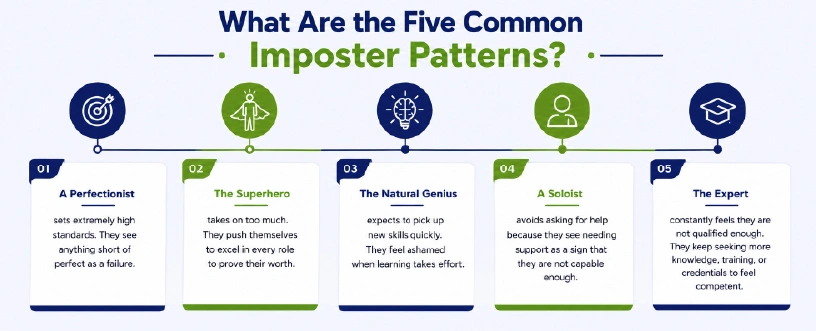
- A Perfectionist sets extremely high standards. They see anything short of perfect as a failure.
- The Superhero takes on too much. They push themselves to excel in every role to prove their worth.
- The Natural Genius expects to pick up new skills quickly. They feel ashamed when learning takes effort.
- A Soloist avoids asking for help because they see needing support as a sign that they are not capable enough.
- The Expert constantly feels they are not qualified enough. They keep seeking more knowledge, training, or credentials to feel competent.
How Does the Imposter Cycle Work?
The imposter cycle is a predictable pattern of anxiety and behavior that starts with a new task and ends right back where it started. The stages include the following:
- Trigger:It is usually a new task, project, or an opportunity.
- Anxiety and response: The task is a trigger, and the fear of being exposed as incompetent begins. This fear tends to produce two reactions that include:
Overpreparing: In this, every detail gets obsessed over to hide any perceived weakness.
Procrastination: During this, the start gets delayed because failure feels inevitable.
- Completion: The tasks get completed in any of the ways.
- Success and relief: The feedback is positive. The relief is also real but brief.
- Rationalization: The success gets explained away rather than accepted. Overpreparation gets credited to hard work rather than skill. Procrastination gets credited to luck.
- Recurring doubt: Nothing gets resolved. If anything, the doubt grows stronger, and the whole cycle starts over at the next opportunity.
Is Imposter Syndrome a Mental Health Disorder?
No, imposter syndrome is not a recognized mental health disorder by DSM-5-TR. It is a psychological pattern or behavioral phenomenon where people doubt their skills, achievements, or talents. They often fear being exposed as a fraud, despite having enough proof of being competent. A mental health professional looks at the broader pattern of thoughts, emotions, behaviors, and the functional impact of other conditions like perfectionism, anxiety, and depression that co-exist with imposter feelings.
How Can Imposter Syndrome Affect Your Mental Health?
If you do not get the right support, it can seriously affect your mental health. Different conditions like anxiety, depression, perfectionism, and burnout frequently coexist with imposter feelings rather than occurring in isolation (Huecker et al., 2023). The other consequences include the following:
- Chronic overworking can lead to exhaustion and burnout.
- Avoiding new opportunities due to the fear of being exposed as inadequate.
- Ongoing anxiety due to persistent self-doubt.
- Strained relationships caused by fears that the partner may eventually recognize perceived shortcomings.
- Difficulty in accepting feedback. This includes praise and constructive criticism, because both can feel threatening to self-worth.
Can Therapy Help With Imposter Syndrome?
Yes, psychotherapy treats the patterns that drive imposter behavior. The patterns include negative automatic thoughts, perfectionistic standards, fear of failure, self-criticism, and difficulty internalizing positive feedback.
Cognitive behavioral therapy (CBT) is commonly used to target the specific thoughts that drive the imposter cycle. This helps replace automatic self-doubt with a more accurate reading of the evidence. Therapy works on the underlying beliefs about competence and worth that keep the pattern in place even after the thoughts themselves start to shift. Self-compassion-focused approaches are also used. They help build a habit of responding to setbacks with understanding rather than criticism.
Is Imposter Syndrome Different From Normal Self-Doubt?
Yes, imposter syndrome is different from normal self-doubt. It involves a chronic fear of being exposed as a fraud that persists despite actual success and clear evidence of competence.
Self-doubt is a situational response. It shows up before a big presentation or a new role. It eases once a person gains experience or gets some reassurance that they’re doing fine. Imposter syndrome works differently. A person can hold a leadership role for years, receive consistent praise, and still discount every piece of positive evidence while treating a single mistake as proof of incompetence. The imbalance between what the evidence shows and what the person believes is the defining feature. This is described as a discrepancy between self-perception and objective performance that persists over time rather than resolving with experience Sakulku (2011).
Imposter Syndrome vs. Low Self-Esteem
The two terms can overlap. A person can experience both at once, but they are not the same pattern. Someone with strong general self-esteem can still experience intense imposter feelings specifically tied to their career or academic identity.
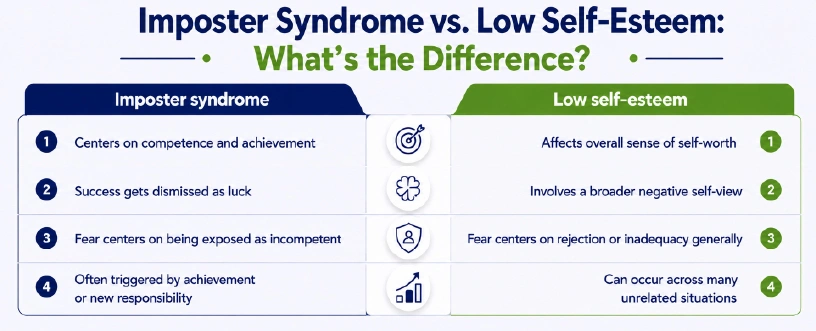
| Imposter syndrome | Low self-esteem |
| Centers on competence and achievement | Affects overall sense of self-worth |
| Success gets dismissed as luck | Involves a broader negative self-view |
| Fear centers on being exposed as incompetent | Fear centers on rejection or inadequacy generally |
| Often triggered by achievement or new responsibility | Can occur across many unrelated situations |
Imposter Syndrome vs. Anxiety
The main difference between imposter syndrome and anxiety is what the fear is centered on. Imposter syndrome involves persistent doubts about your abilities, accomplishments, or sense of deserving success. Like, “I’m not as capable as people think, and they’ll eventually find out.” However, anxiety is typically driven by worry about potential problems, threats, or uncertainty. Like, such as, “What if something goes wrong, and I can’t handle it?”
The two can overlap. Fear of being exposed as inadequate can fuel anxiety, while anxiety can make self-doubt feel more convincing. Understanding the distinction can help clarify whether the primary concern is perceived inadequacy, fear of future outcomes, or both.
Imposter Syndrome vs. Perfectionism
Perfectionism is about the need to meet extremely high standards, while imposter syndrome is about doubting whether you deserve your success or are truly as capable as others believe.
The two often go hand in hand. A perfectionist may focus heavily on mistakes or flaws, making it easier to doubt their own competence. Those doubts can then fuel imposter feelings and create pressure to perform even better.
Not every perfectionist experiences imposter syndrome. The important distinction is whether high standards coexist with confidence in your abilities or with a persistent belief that your success does not reflect your true competence.
How Can You Overcome Imposter Syndrome?
Overcoming imposter feelings involves different approaches, including the following:
- Talk about your fear or thoughts with your friend or mentor.
- Feeling inadequate does not mean you are incompetent. These are mere feelings and are not true.
- Keep a folder of your positive feedback and achievements. You can read it whenever the imposter feelings creep in.
- Aim for steady work instead of looking for perfection.
- Talk to a mental health professional for better support and help.
Take the First Step Toward Real Confidence With Inland Empire Behavioral Group
If any of this sounds familiar, it may be time to reach out to a licensed mental health provider:
- Interferes with work, school, or daily functioning
- Drives chronic overworking or burnout
- Feels difficult to manage without outside support
At Inland Empire Behavioral Group, we offer personalized treatment plans built around your specific needs, not a generic template applied to everyone. Our certified psychiatrists provide care for every age group, with flexible in-person and telehealth scheduling options across Riverside and Colton, CA.
You don’t have to keep carrying this alone.Contact us orbook an appointment today to take the first step.