
Imagine you are sitting quietly in a meeting room and the person sitting next to you is clicking a pen or tapping a fingernail on the desk. For everyone else around you, it might be a normal part of life. But if you are experiencing misophonia, your heart starts beating fast, and you become so irritated by an overwhelming wave of anger. You may feel like you can’t sit, become panicked, and you really want to escape from the situation.
That’s how Misophonia feels!
It’s a neurological condition in which people become extremely irritated by just the sound of their surroundings, such as chewing, tickling, tapping, etc. Every person experiences this condition differently, as some individuals control their responses and some just burst out. However, in most of the scenarios, individuals may not be able to complete their tasks, which ultimately affects their everyday life.
Most people confuse misophonia with anxiety, as there are similarities in the symptoms. However, anxiety and misophonia are two distinct conditions, and both have differences. As per the study published by Andrea E. Cavanna and Stefano Seri, they described how misophonia affects distinct emotional and autonomic responses that overlap with other neuropsychiatric conditions such as anxiety.
Understanding this condition is crucial as it helps in early treatments.
Misophonia Definition
Misophonia is a neurological condition in which people have issues hearing different sounds. The term “misophonia” originates from the Greek words “miso,” which means hate, and “phonia,” signifying sound. This condition was coined by Professor Pawel Jastreboff and doctor Margaret M. Jastreboff in 2001. Although this condition is not officially recognized as a diagnostic criterion, it leads to severe challenges in everyday life activities. People in this state are usually triggered by sounds like the tick-tock of a clock, chewing, tapping on the table, a sneeze, a horn, etc. They experience severe distress and irritation as it’s a disturbing condition.
However, most people think it’s normal for every human being to experience such things, but these sounds trigger more than a typical irritation; it makes one become enraged or avoid the situation. In most of the cases, people experiencing misophonia also struggle with anxiety, as the disturbing stimuli make their brains go into fight-or-flight mode, where their brains interpret such voices as threats.
What are the Symptoms of Misophonia?
Misophonia can be recognized very easily as the symptoms are very clear. As we have already discussed, it’s a negative reaction to hearing sounds a person hears from the outside world. It’s basically the internal feelings and emotions that show up in the physical reactions. Here are some of the common symptoms that may help one to recognize the condition in a better way:
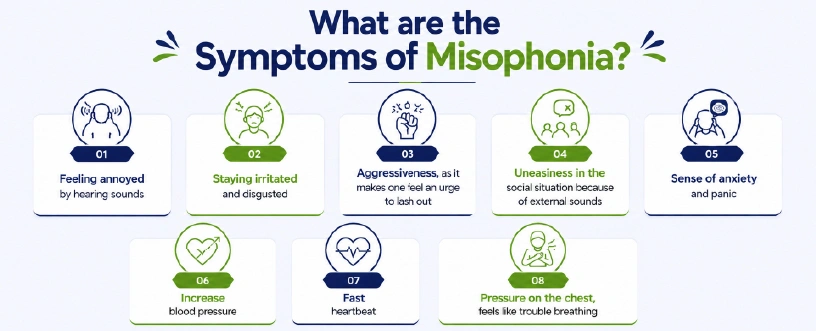
- Feeling annoyed by hearing sounds
- Staying irritated and disgusted
- Aggressiveness, as it makes one feel an urge to lash out
- Uneasiness in the social situation because of external sounds
- Sense of anxiety and panic
- Increase blood pressure
- Fast heartbeat
- Pressure on the chest, feels like trouble breathing
This condition usually develops in childhood but can occur in the teenage years, also a heritable condition that runs in families. If you feel like you are becoming irritated, which makes you reach that extreme level, meet a mental health professional immediately. If it remains untreated, it may lead to several other mental health disorders and also impact personal life, as a person may avoid family gatherings, friendships, work commitments, etc.
What are the Common Misophonia Triggers?
There are various triggering sounds of misophonia. Every person has difference experience with this condition; some of them include
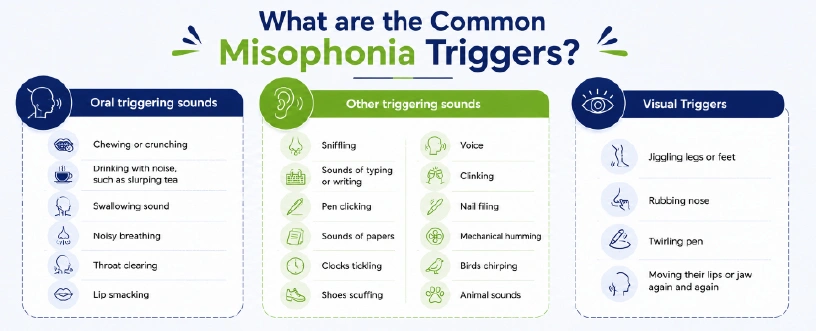
Oral triggering sounds
- Chewing or crunching
- Drinking with noise, such as slurping tea
- Swallowing sound
- Noisy breathing
- throat clearing
- lip smacking
Other triggering sounds
- sniffling
- Sounds of typing or writing
- pen clicking
- Sounds of papers
- clocks tickling
- shoes scuffing voice
- Clinking
- nail filing
- mechanical humming
- birds chirping
- animal sounds
Visual Triggers
- Jiggling legs or feet
- Rubbing nose
- Twirling pen
- Moving their lips or jaw again and again
If you feel like you or someone around you is going through this situation, then it’s alarming. Seek professional support immediately. It causes serious consequences in everyday life and leads one towards severe mental health disorders.
What is Anxiety?
Anxiety is a psychiatric condition that causes unease, fear, and worry about the upcoming situation. Although most of us remain anxious from time to time while dealing with everyday life stresses.People who are going through persistent anxiety can have consequences in everyday life, as it leads to panic attacks and makes them avoid the outside world. People in this state also have physical symptoms such as unexplained muscle pain, stomachaches, diarrhea, and more. Moreover, in some cases, this condition can become a continuous feeling even when there is no external threat.
Why Do Anxiety and Misophonia Co-Occur?
People experiencing misophonia and anxiety have overactivation in the brain region that controls emotions and the perception of upcoming threats. Many scientists have done research on this, and they have found that people with misophonia have differences in brain regions, which cause them to behave differently. So the area that controls emotions, such as the salience network, heightens the anxiety while encountering a triggering point. This area of the brain amplifies the emotional significance of these sounds, creating a response that is unable to be ignored.
However, if we talk about anxiety, the amygdala creates the classic fight-or-flight response in the individual, which makes them panic or worry excessively, or rather, makes them leave the situation. The part, such as the thalamus, acts as a sensory part of the brain that provides information before it goes to consciousness. Moreover, hyperactivation also shows a third, different pattern in misophonia. So, the connectivity between the auditory cortex and both limbic regions shows that the triggering sounds don’t just get heard; they are emotionally processed in the brain regions.
That is how individuals in this state often feel physical urges to escape or respond when triggered, which ultimately leads to anxiety.
What Does a Misophonia & Anxiety Episode Look Like?
A person was sitting in a fine dining restaurant with their close friends, and suddenly they started to be irritated by the sounds of tapping on the table. Although it’s happening at the other table, this small triggering sound makes one feel so irritated that he left the restaurant. That’s because leaving the triggering situation validates the nervous system, as it’s an outside experience that can be better by just leaving the situation.
Whereas anxiety can be activated simply because a person is thinking about something they are concerned about. For example, if a person has a stage performance the next day, they might think that they are unable to perform because they fear the situation, but fearing it and thinking about it again and again leads to anxiety.
So basically, anxiety is an internal experience, and misophonia is external, and both can co-occur. A person who is going through a misophonic situation can have anxiety as they think about it, and the brain remains on alert, which makes the person remain ready for the upcoming situation. So that’s how a person who is more anxious may react with more intensity to auditory or visual stimuli from the outside world.
Anxiety Vs Misophonia
Both are distinct conditions, people with anxiety remain worried about the future, and individuals with misophonia get irritated by little external stimuli.
Here is how both conditions have differences:
| Feature | Anxiety | Misophonia |
| Primary features | It leads to excessive worries, thoughts, or social cues | It triggers through specific sensory inputs such as sounds |
| Emotion | People in this state fear, dread, or have excessive worry | It triggers rage, anger, or panic |
| Anticipatory Anxiety | Individuals in this state remain in fear of future outcomes or panic attacks | People in this remain in fear of encountering a specific trigger sound |
| Context | It’s a broader term in which different types occur | It’s an independent condition that causes issues with sensory tolerance |
| Brain pathways | Anxiety activates the amygdala and prefrontal cortex | This condition activates the anterior insula |
How Does Misophonia Impact Life?
Misophonia severely affects day-to-day life; it strains relationships and also affects work and other important aspects of life. People who are going through this state might not understand it so deeply, but the reactions to this condition go beyond just being annoyed. Individuals going through this state tend to remain isolated and alone as they fear they might react to their stimuli and might embarrass people around them.
People who are constantly being exposed to triggering sounds struggle with stress, anxiety, and even social withdrawal, which is why talking support earlier is crucial. Here is how it impacts personal life:
- Relationship issues: individuals struggling with this condition feel that every day sounds like a big thing, which can lead to tension and misunderstandings in personal relationships. This ultimately makes the individual feel overwhelmed and makes the family and friends feel confused or hurt.
- Life challenges: people experiencing this state have issues managing concentration on the important aspects of life, such as school and work settings.
- Emotional distress: individuals experiencing misophonia often feel judged, which makes them manage their feelings alone, ultimately leading to emotional distress.
- Avoidance behavior: Misophonia makes one try to avoid the situation that triggers their reaction, although it might provide temporary relief, but in the long run, it leads to social isolation.
- Affects Quality of life: Individuals in this state also experience several mental health conditions because of excessive stress. These conditions can include depression, low self-esteem, and a diminished quality of life.
What are the Causes of Misophonia?
The exact cause of misophonia is still unknown, but there are some factors that make one more vulnerable to developing this condition.
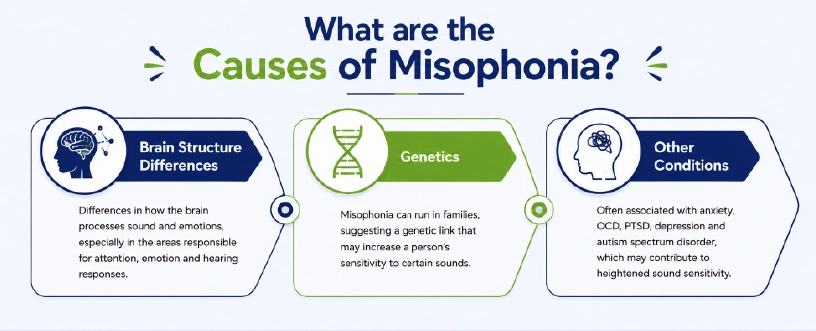
- Brain structure differences.
- Other conditions.
- Family history or genetics.
Brain Structure Differences
As per the research, individuals who are going through this state have differences in their brain structure. These differences make one more prone to being triggered by external sounds. It controls how you process the voices and sounds around you, as hearing voices is part of the brain’s built-in system. So that is why a person can feel emotions, anger, and even happiness.
Genetics
This condition runs in families, meaning that if anyone in your close family has been through this condition, there is a high chance that you may also develop it. It is because there is also at least one genetic structure that plays a role.
Other conditions
This condition is also very common in people who are going through other neurodivergence or mental health conditions. Some of the conditions include:
- Attention-deficit/hyperactivity disorder (ADHD).
- Autism spectrum disorder.
- Tourette syndrome.
Mental Health Conditions
Some of the people who are struggling with mental health disorders are also at high risk of developing this condition; these include:
- Major depressive disorder (MDD).
- Obsessive-compulsive disorder (OCD).
- Post-traumatic stress disorder (PTSD).
- Borderline personality disorder (BPD).
Moreover, this condition is also more common in individuals who have obsessive-compulsive traits. As per the research, around 2.8% of people with OCD traits also have misophonia.
Professional Diagnosis
Although there is currently no proper diagnostic test for this condition, it is not classified as an independent diagnosis in the DSM-5-TR. However, mental health professionals check on the condition of the patient and look for the signs of other mental health disorders, such as ADD, OCD, or any other mental health disorder. They check on the history of the patient by looking at the symptoms, onset, and nature. A mental health professional checks the severity by following some professional ways, such as the Amsterdam Misophonia Scale (A-MISO-S) and the Duke Misophonia Questionnaire (DMQ).
Moreover, they also check if their personal and professional lives are being impacted because of this condition. Through evaluation, they diagnose the condition and then recommend treatments as per the severity of the condition.
Treatment Approaches
Its highly manageable condition with the right combination of treatment. Only a mental health professional can recommend the best treatments; they combine medications with therapies for better outcomes. A certified mental health professional checks on sensory and anxiety-related conditions and then helps determine the most appropriate path towards treatments.
Some of the common therapies include:
1. Cognitive Behavioral Therapy (CBT)
CBT is an evidence-based approach that helps people to understand their thoughts in a more positive manner. Through this, patients understand their condition as a nervous system reflex rather than a character flaw or overreaction. Also, cognitive restructuring of thoughts works to manage the emotional intensity of reactions over time and ultimately helps manage this condition in a better way.
2. Exposure and Response Prevention (ERP)
It is structured psychotherapy in which a mental health professional gradually exposes the patient to trigger sounds in a controlled setting. The main goal of this therapy is to build tolerance to distress and reduce the fears associated with it. It interrupts the association between the fears and the triggers by making the person face their fears.
3. Sound-Based Interventions
In this therapy, a mental health professional makes the patient listen to the sounds that they fear. These can be through noise machines, sound apps, and noise-buffering headphones. However, this reduces the triggering sounds in everyday life.
4. Mindfulness and Somatic Approaches
In this, a mental health professional makes the patient practice grounding, which helps the patient pay attention to the body. This helps in regulation at the moment by doing deep breathing. These somatic ways help build a way of tolerance. Mindfulness-based practices offer further support, which makes one feel better over time.
Note: This condition can occur with other mental health disorders; it’s better to get professional treatment if you feel like you cannot manage your condition and it’s causing devastating issues with day-to-day life. However, in some cases, a psychiatrist may evaluate whether psychiatric medication could support symptom management alongside therapy. And if medications are helpful, they may also recommend medication in combination with therapies for betterment.
Your Path towards Wellness With Inland Empire Behavioral Group
Living with misophonia or anxiety can be challenging, but it’s manageable with the right treatments. If you feel like you or any of your loved ones are going through this situation, get help immediately. Help is within reach now!
At Inland Empire Behavioral Group, we’re here to help you feel better. We have a certified team of mental health professionals who offer compassionate treatment plans that fit your specific needs. We accept major insurance plans so you don’t have to worry about your bills. Our Experts offer a safe, judgment-free space where you feel comfortable talking about your concerns. If you have issues like traveling or have a busy schedule due to workload, you can also get treatments virtually from the comfort of your home, as we offer telepsychiatric appointments as well.
Take the first step today and book your appointments.